Wednesday, April 05, 2006

The Greenhouse We Don't Want is Here

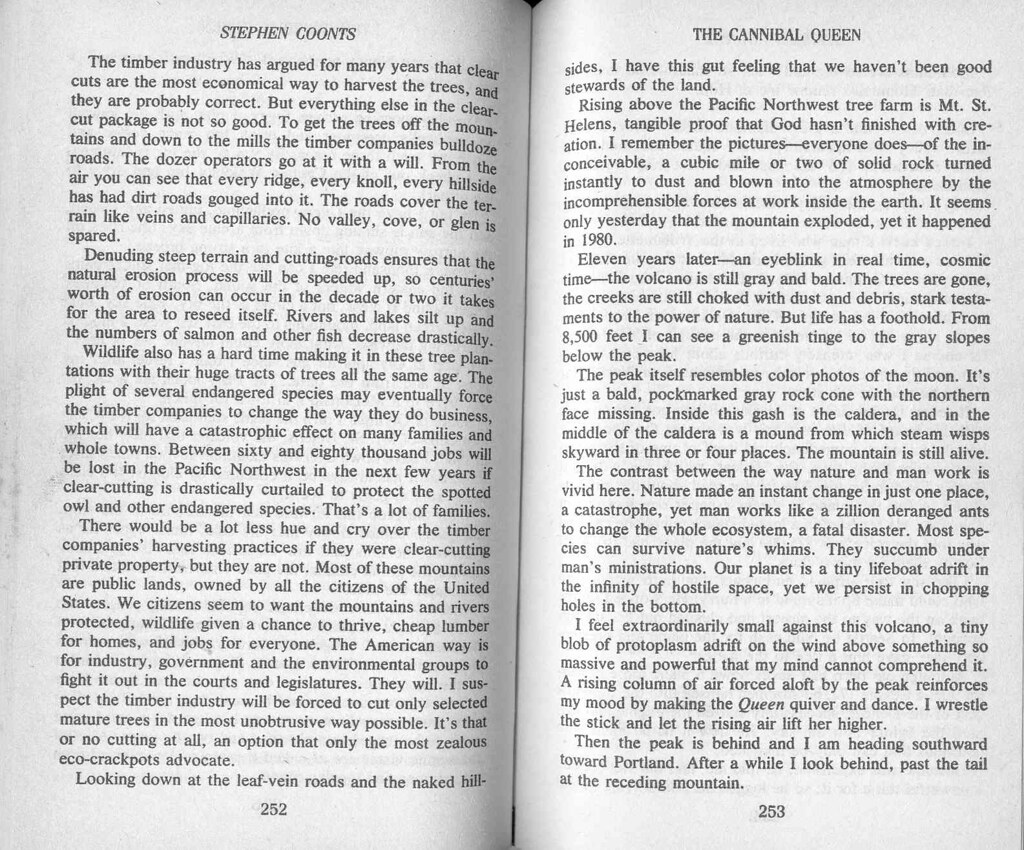
From one of my favorite books comes the "call to environmentalism" theme of this collection of essays. The book is The Cannibal Queen, which is a memoir about restoring an old plane and then flying her to each state of the United States, and the observations along the way.

http://www.amazon.com/gp/product/0671038494/sr=8-2/qid=1144287756/ref=pd_bbs_2/102-1831096-2236938?%5Fencoding=UTF8

From pages 251-253
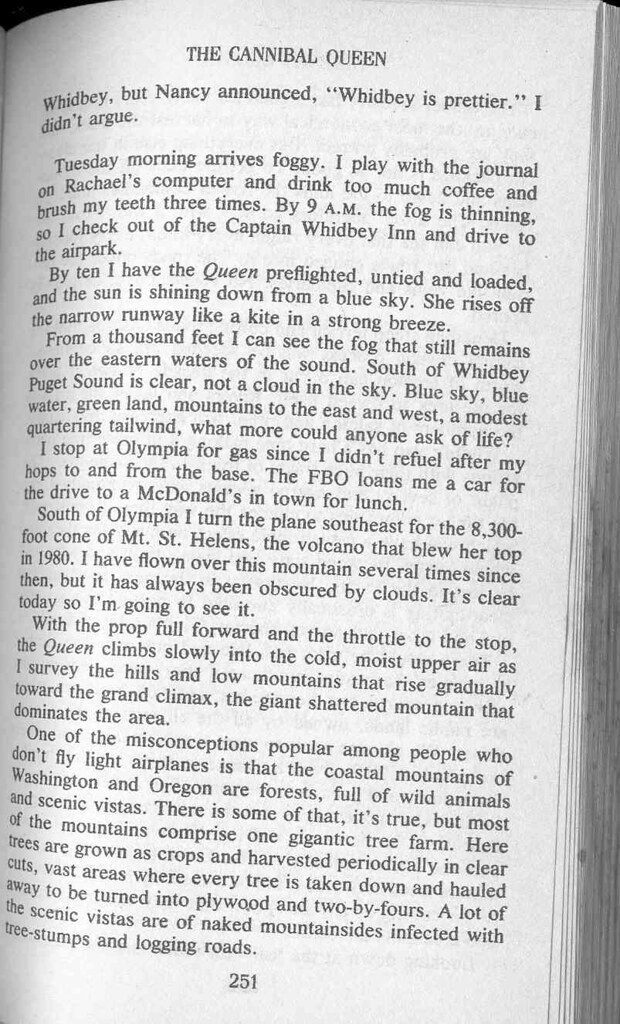
cannibalqueen1

cannibalqueen2

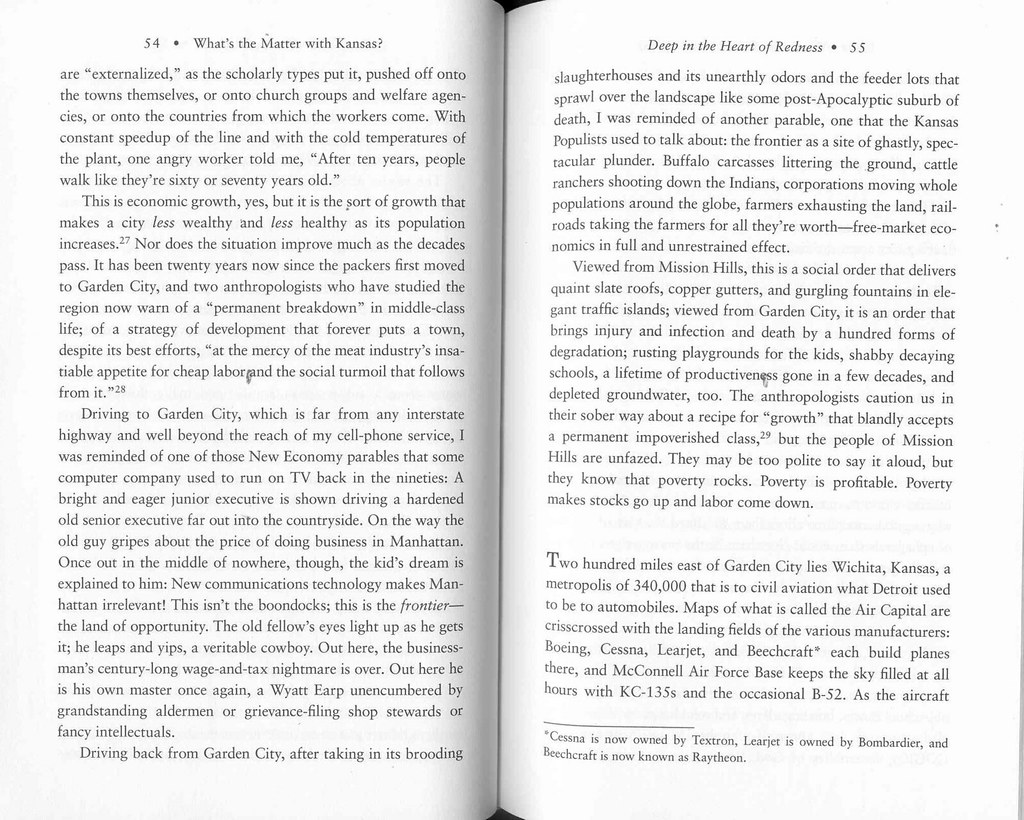
Years later, Thomas Frank gives another description of the expression of our times in “What’s the Matter with Kansas”. This book isn’t about the environment, at least not directly. However, like “The Cannibal Queen”, an introspective writer examining other things manages to capture something critical to our future as a species.

http://www.amazon.com/gp/product/0805073396/qid=1144288586/sr=2-1/ref=pd_bbs_b_2_1/102-1831096-2236938?s=books&v=glance&n=283155
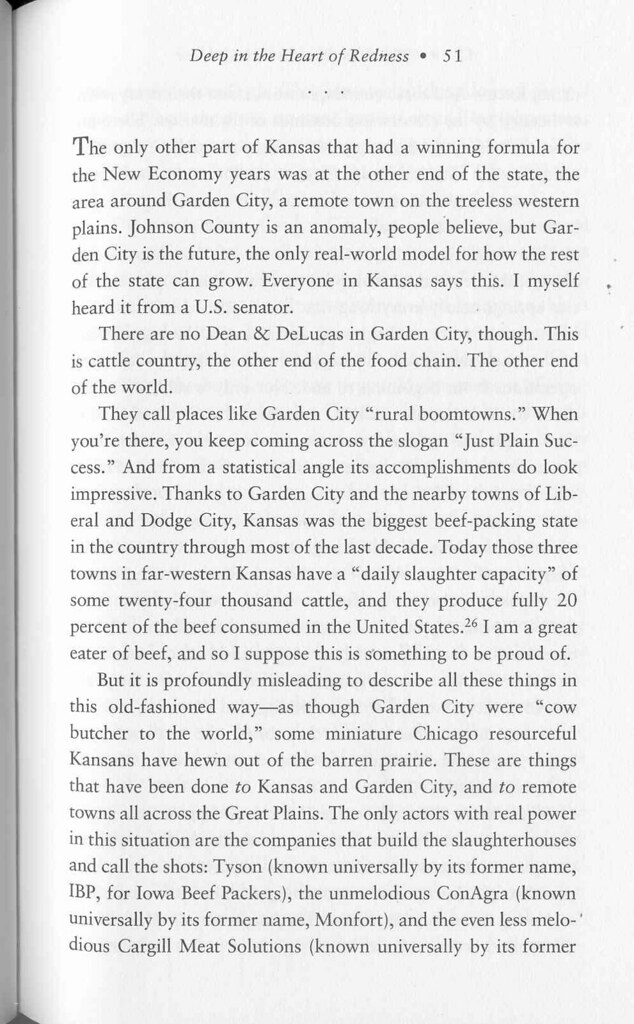
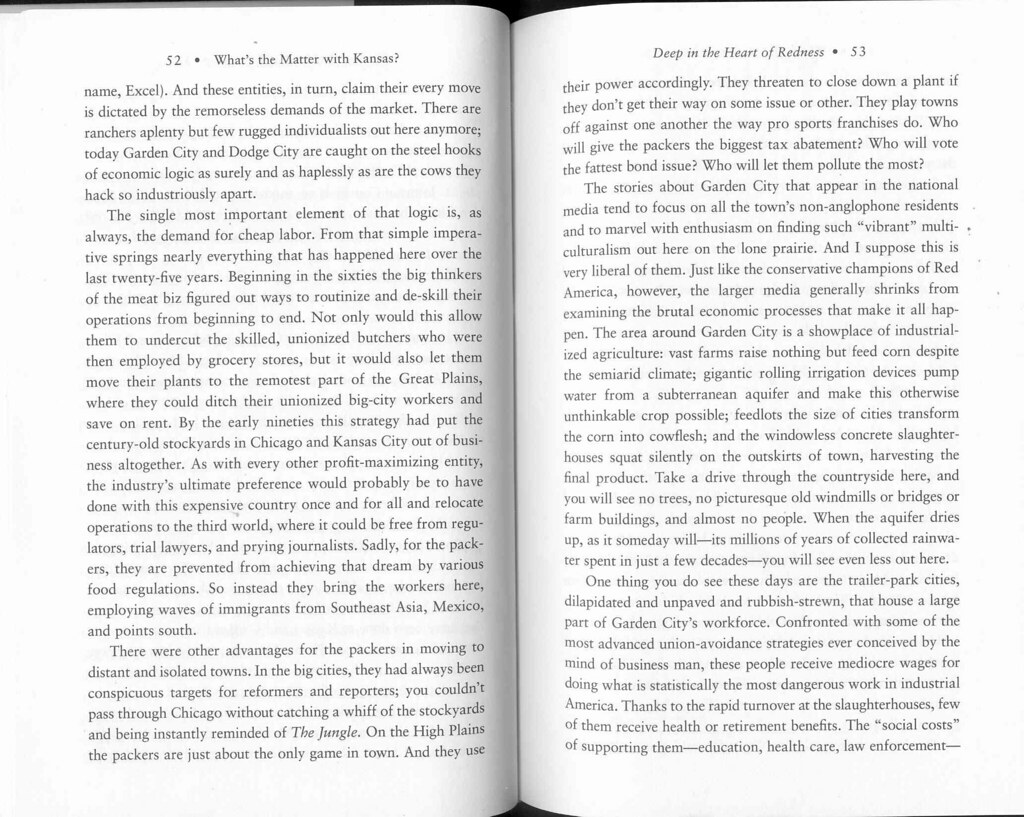
whatsthetroublewithkansas1

whatsthetroublewithkansas2

whatsthetroublewithkansas3

If you haunt cnn.com or any other major news source, you would have probably seen an article last week about coral dying off in the Caribbean. I’m very much reminded of the insidious invasion of Caulerpa taxifolia in the Mediterranean, which is an ecological disaster that few people seem to be very much worried about. Possibly, like the Caribbean coral holocaust, because it occurs beneath the waters of the oceans, and is therefore completely invisible to all but a few observing eyes and instruments.

"Meinesz's fight against C. taxifolia—and against the arrogant ill-informed oficials who allowed it to prosper—may be a lost battle, but his combat journal is enormously valuable. We will never have any such well-documented record of how the gypsy moth, the whelk tingle, or the house sparrow established their beachheads and rolled on to conquest."— from the foreword of Killer Algae by David Quammen

Link to check out the book “Killer Algae”

http://www.amazon.com/gp/product/0226519236/qid=1144289307/sr=2-1/ref=pd_bbs_b_2_1/102-1831096-2236938?s=books&v=glance&n=283155
Unprecedented die-off of Caribbean coral reefs

The barriers, which limit damage from weather, are key to the region's tourism and fishing.

By Seth Borenstein
Associated Press

WASHINGTON - A one-two punch of bleaching from record hot water followed by disease has killed ancient and delicate coral in the biggest loss of reefs scientists have ever seen in Caribbean waters.

Researchers from around the globe are scrambling to figure out the extent of the loss. Early, conservative estimates from Puerto Rico and the U.S. Virgin Islands find that about one-third of the coral in official monitoring sites has recently died.

"It's an unprecedented die-off," said Jeff Miller, a National Park Service fisheries biologist, who last week checked 40 stations in the Virgin Islands. "The mortality that we're seeing now is of the extremely slow-growing reef-building corals. These are corals that are the foundation of the reef... . We're talking colonies that were here when Columbus came by have died in the past three to four months."

Some of the devastated coral can never be replaced because it grows only the width of one dime a year, Miller said.

Coral reefs are the basis for a multibillion-dollar tourism and commercial-fishing economy in the Caribbean. Key fish species use coral as habitat and feeding grounds. Reefs limit the damage from hurricanes and tsunamis. More recently they have been touted as possible sources for new medicines.

If coral reefs die, "you lose the goose with golden eggs" that are key parts of small island economies, said Edwin Hernandez-Delgado, a University of Puerto Rico biology researcher.

On Sunday, he found a colony of 800-year-old star coral - more than 13 feet high - that had just died off Puerto Rico.

On Wednesday, Tyler Smith, coordinator of the U.S. Virgin Islands Coral Reef Monitoring program, dived at a popular spot for tourists in St. Thomas and saw an old chunk of brain coral, about three feet in diameter, that was at least 90 percent dead from the disease called "white plague."

The Caribbean is actually better off than areas of the Indian and Pacific Oceans where mortality rates - mostly from warming waters - have been in the 90 percent range in past years, said Tom Goreau of the Global Coral Reef Alliance.

And with global warming, scientists are pessimistic about the future of coral reefs.

"The prognosis is not good," said biochemistry professor M. James Crabbe of the University of Luton near London. In early April, he will investigate coral-reef mortality in Jamaica. "If you want to see a coral reef, go now, because they just won't survive in their current state."

New sea-surface temperature figures show the sustained heating in the Caribbean last summer and fall was by far the worst in 21 years of satellite monitoring, said Mark Eakin, coordinator of the National Oceanic and Atmospheric Administration's Coral Reef Watch.

The heat causes the symbiotic algae that provides food for the coral to die and turn white. That puts the coral in critical condition. If coral remains bleached for more than a week, the chance of death soars, according to NOAA scientists.


Our culprit is global warming, which was almost immediately discarded as a myth, mainly by people with a vested interest in the consumption continuing. Pressure was applied to government, the issue politicized, those who wanted reductions in greenhouse gases were patronized as washed up hippie environmentalist fruit cakes, and those that quietly insisted that the caring for all creation was a religious duty shared by all humanity and that the place of man was as a servant to the earth and not the center of it were dismissed as socialists or irrelevant.

Worse, the issue was portrayed here in the U.S. as one of defending American sovereignty, patriotism, and authenticity. Images of rugged individualism were ordered in by the generals of capitalism against the latte-sipping limousine liberals that were out of touch with ordinary Americans. The only trouble is, anyone with any amount of analytical skill, could read and slowly appreciate that the trend was not good. In the 1990s, a wait-and-see approach was commonly adopted by even ardent environmentalists. No one wants to be the one that cries wolf. And, you only have so much reputation capital as an activist. But now, I think we have a consensus.

Powerless in the face of corporatism, most people in America seem to not have many choices when it comes to causing the emission of so-called greenhouse gases. Sure, everyone could cut their energy consumption in, say, half. But we love using electricity, and we love oil. We are also not unique. Everyone on the planet loves using electricity and loves consuming oil. We in the U.S. just seem to have perfected the conspicuous consumption of it.

There is little incentive to walk instead of drive when no one else in the neighborhood walks the 40 minutes to the grocery store. There is little incentive when it’s actually physically unsafe to walk the 40 minutes to the grocery store. And that is if you happen to have a grocery store relatively close to you.

The “town square” mentality of new construction doesn’t help either. It’s mostly a charade. An unintentional charade that was probably executed with the best of intentions, of course, but it is still a charade. Those Town Squares, where walking paths occupy otherwise unbuildable space, and a nod is made towards public transit, still require almost every resident to own and operate a car. They’re ornamental and not functional. The bedroom community reigns supreme, and is remarkably intractable when it comes to modification.

The older neighborhoods aren’t a sure bet either. Move to them, and see your local shopping evaporate because a Wal-Mart was built 24 miles to the south-east. The scythe-wielding harbinger of completely empty Main Street business districts has been silently and darkly standing sentry over all of us for at least two decades.

Is Wal-Mart and the centralization of shopping necessarily a bad thing? No. Maybe in the case of greenhouse gas emissions we cause less damage with centralized shopping than we would with decentralized shopping, where every place requires shipping to and from, and every little store duplicates the overhead of waste. I don’t know which is environmentally better, but I wouldn’t be surprised either way. All I know is that I’m chained to a car of some sort, and unless technology gets a move on, we’ll run out of oil before having anything close to an equivalent ubiquitous replacement for transportation.

Why every single home in Southern California does not already have solar panels on the roof yet, I don’t know. Is it simply cost? Is it because it’s not “cool” enough? Too much trouble? Why in the world every single large commercial building isn’t required to have co-generation on their vastly spreading flat roofs, to reduce the need to burn coal or natural gas for electricity, defeats my minor-league brain. It would seem to make perfect sense.

This brings up the question, however, of whether or not it’s really worth it to be able to drive when the biodiversity of the planet is failing all around us. Here’s a series of essays that document some of the damage.

COMMENTARY
Feeling the Heat: The World Wakes Up
By Jim Motavalli

http://www.emagazine.com/view/?3136&src=QHAEN

Two thousand and six is emerging as the year Americans finally wake up to the reality of global warming. Of course, E has been hammering away at the issue for six years or more, but now it has momentum, with the release of several new books and a Time magazine cover story ("Be Worried, Be Very Worried") April 3.

An ABC/Time/Stanford University poll accompanying the article confirmed that Americans are finally focusing on the problem. Today, 85 percent of Americans believe that global warming is occurring, versus 13 percent who don't. Sixty percent of respondents admit to worry about it either "a great deal" or "a good amount." Sixty-eight percent think the federal government should do more to combat it. (It's doing virtually nothing now.)

But Americans remain pretty confused. A stunning 64 percent in the poll think there's "a lot of disagreement" among climate scientists on the reality of global warming, when there's actually a near total consensus. And 54 percent think climate change is "a problem for the future," versus only 44 percent who think it's already a serious problem.

Given that misconception, we thought it might be helpful to provide some examples of climate change that are happening right now. Let's make this clear: We are already causing major disruption to the Earth's weather patterns, and we're seeing huge effects, from melting polar ice to shifting species, from rising seas to dying coral. For humans, this poses grave dangers, but for some species it means extinction. "There will be no polar ice by 2060," says Larry Schweiger, president of the National Wildlife Federation. "Somewhere along that path, the polar bear drops out."

Imperiled polar bears.
© Gary Braasch
These excerpts are from E's book Feeling the Heat: Dispatches from the Frontlines of Climate Change (Routledge). Our report on ongoing climate change came out in 2004, before Americans were as focused on global warming as they are now. But much of the evidence cited in the Time article and in other, more recent books first appeared between covers in Feeling the Heat. The book would probably have sold better if we simply sat on it for two years! Here's some of what we saw around the world in 2004, from the pages of Feeling the Heat (which is illustrated, as is this article, with dramatic photographs by Gary Braasch):

The California Coast: Migrating Species

In 1949, a combination of state and federal organizations began monitoring physical, chemical, biological and meteorological facets of the California Current under the auspices of the California Cooperative Oceanic and Fisheries Investigations program, known as CalCOFI. It was designed in part to track many factors affecting commercially important fish species such as mackerel and sardines. The data gathered under CalCOFI include air temperatures, wind speeds, nutrient levels, salinity, water temperature on the surface and deep below the surface, and the abundance of larval fish and zooplankton--the smallest marine animals.

What happens if you watch those data change over the years? Your findings might echo those of John McGowan, an oceanography professor at Scripps Institution of Oceanography in San Diego: As water temperatures have risen, the base of the marine food chain off the coast of California has crashed. And one by one, the fish and birds farther up that food chain are crashing, too.

Life in the ocean begins with tiny plants known as phytoplankton. Like all plants, phytoplankton need light to drive photosynthesis and nutrients to feed the process. Although it's somewhat counter-intuitive, the richest and most nutritive ocean waters are the coldest and heaviest. Strong winds do the work of stirring the system and pulling the nutrient-rich waters up toward the light.

The first problems showed up because of El Niños, short-term changes in ocean temperatures that tend to increase the warm water along the western U.S. coastline, reducing the food that boosts the phytoplankton. But researchers like McGowan noticed a difference between the early El Niños and the later ones. Numbers of zooplankton--the tiniest animals in the food chain, which depend on the phytoplankton--dropped during the El Niño of 1957-1959 and then quickly rebounded. But after subsequent El Niños during the 1983 to 1984 and 1997 to 1998 seasons, the zooplankton didn't come back.

California's tidepools are changing.
© Gary Braasch
In 1995, going back through the accumulated years of data, McGowan reported a staggering finding in Science: Zooplankton numbers in the California Current had dropped by 70 percent. "It's the largest change ever measured in plankton productivity in the ocean," McGowan says. "This enormous change in the zooplankton in the California Current could not be detected from year to year. It took several decades before we discovered this big drop, by at least 70 percent or even up to 80 percent."

With that huge loss at the base of the food chain, reverberations throughout the system that depended on it were inevitable. Since McGowan's study came out, declines of species throughout the area have been attributed to the loss of zooplankton and the warming water.

The crash showed up in fish, although it's often tough to tell if such declines come from too many nets or too little fish food. But even when researchers look at species for which human markets have no appetite, they find precipitous declines. The larvae of Leuroglossus stilbius--a fish of so little market value that it doesn't even have a name in English--historically are the third most abundant in the California Current. Larvae counts for it dropped 50 percent after 1977. Another similarly ignored species with no common name, Stenobranchus leucopsarus, saw its larvae drop 42 percent after the sharp temperature rise. Its larvae are typically the sixth most abundant in those waters.

In 1967, aerial surveys found 70 square miles of kelp forests along the long California coastline. In 1989, that number dropped 42 percent. By 1999, the most recent year for which data are available, the total plummeted to just 17.8 square miles--down 75 percent from the 1967 survey.

George Divoky with a Black Guillemot, whose population crash has been related to global warming.
© Gary Braasch
But the most dramatic decline came to the sooty shearwater, a predatory seabird at the top of the marine food chain. "In the 1960s and 1970s they were present in the tens of millions," McGowan says, "the largest population of pelagic [marine] seabirds in the entire California Current. They dominated it. Millions and millions of them." The birds feed on juvenile fish and larger zooplankton. Researchers began looking at the birds regularly in 1987. By the 1990s, the population of sooty shearwaters had crashed, with numbers down 90 percent. —Orna Izakson

New York: The Virus Specter

Heat stress is probably the most obvious thing people think of when global warming comes up. Other effects are more subtle, but no less deadly. Higher rates of ground-level ozone are a major respiratory irritant, and vector-borne diseases thrive in warmer temperatures. And that's the problem that's keeping the city's public health officials up nights.

New York City had never had a case of West Nile encephalitis before 1999, but that hot summer--the hottest and driest in a century--62 cases were reported in the region. In all, 8,000 New Yorkers were infected, and seven people died.

Between August 12 and 23, six people were admitted to Flushing Hospital in the borough of Queens with high fevers and headaches. Routine culture screens for bacterial or fungal microbes were negative, leading to a growing consensus the patients were suffering from an encephalitis-like disease of viral origin. Within three weeks, three elderly patients died.

Tests at the Centers for Disease Control and Prevention in Atlanta and Fort Collins, Colorado revealed that the illness was close to the St. Louis encephalitis, which had never previously touched New York City. By September 6, there were five confirmed victims of the new virus, and 34 suspected cases. By September 9, exotic birds began dying in the Bronx Zoo. A general health warning was issued, and city residents began to get used to helicopters overhead spraying clouds of malathion and pyrethriod pesticides. By September 21, scientists had isolated and identified the specific virus, not St. Louis encephalitis but West Nile.

West Nile is spread by a mosquito, Culex pipens, which breeds in stagnant pools of water. According to several prominent scientists, drought is the key factor in spreading West Nile virus. Outbreaks require an unfortunate series of events, they say. According to Dr. Dickson Despommier, a professor of public health at Columbia University, Culex mosquitoes often live in close proximity to people because of the stagnant water they carelessly let stand. While the mosquitoes' favorite prey is birds, periods of high heat and drought send such common urban-dwelling species as crows, blue jays and robins out of the city in search of fresh water. City bird populations are further reduced as unlucky individuals are bitten and killed by West Nile infection.

"By reproductive imperative the mosquitoes are forced to feed on humans, and that's what triggered the 1999 epidemic," Despommier says. "Higher temperatures also trigger increased mosquito biting frequency. The first big rains after the drought created new breeding sites." It took Hurricane Floyd, which passed through New York on September 16, to break the weather cycle that led to the outbreak.

Despommier says this same pattern is also discernible in recent West Nile outbreaks in Israel, South Africa and Romania. In Bucharest, Despommier's investigation turned up abandoned buildings whose basements were full of water, a perfect Culex breeding ground.

Another prominent proponent of the West Nile global warming connection is Dr. Paul Epstein of Harvard University. "Droughts are more common and prolonged as the planet warms," he says. "Warm winters intensify drought because there's a reduced spring runoff. The cycle seems to rev up in the spring, as catch basin water dries up and what's left becomes organically rich and a perfect mosquito breeding place. The drought also reduces populations of mosquito predators."

In 2002, West Nile spread across the country, appearing in 44 states and the District of Columbia. Five provinces of Canada were also affected. In a growing scientific consensus, public health officials believe the next drought will give this serious virus even a wider reach. Spraying certainly hasn't stopped these infectious bugs. Researchers at France's University of Montpellier said in mid-2003 that a mutation in the West Nile mosquitoes' genetic code resulted in their singular resistance to pesticides. —Jim Motavalli

Florida: Dying Coral

Florida's vulnerable coastline.
© Gary Braasch
I first heard about coral bleaching from Billy Causey, the manager of the Florida Keys National Marine Sanctuary. We were sitting in his office deep in a 67-acre hardwood hammock on Marathon Key. It's a place where ospreys, egrets, cormorants, fat black snakes, hermit crabs, parrot fish, even an old tropical fish collector like Billy can still find refuge from the Kmart mall sprawl out on Route One. Thick set with iron-gray hair and sea-gray eyes, Causey, who moved to the Keys in 1973, sounds like some Old Testament Jeremiah as he recalls the gradual decline of the reef during the years he's been here.

Unfortunately, while among the most diverse of marine habitats, the world's massive coral colonies are also fragile structures, living within a narrow range of clarity, salinity, low-nutrient chemistry and temperature.

"Throughout the '70s we saw various problems but constantly clear waters with typical hundred-foot visibility," Billy recalls.

"In 1979, we had a warm water spell and big vase sponges started dying," he continues. "In June of 1980 we had a pattern of slick calm weather and thousands of fish were killed. This was the first signal to me that things were tilting the wrong way. Then in 1983, with an explosion of onshore development, there was an urchin die-off. In 1984, there was another doldrums and the reefs bleached down to Key West. Maybe five percent of the coral died. In May of 1986, when we had hardly seen black band disease [characterized by dark bands of dead coral on otherwise healthy specimens], I went out to take a picture of it. I saw four-dozen massive outbreaks within an area about 400 feet in length."

Causey pauses to listen to a passing bird cawing over the still, aquamarine waters of the Gulf a few yards away. Further north I've noticed the fringing waters of Key Largo have taken on a greenish lime Jell-O hue.

"In June of 1987 we got a slick calm," he continues. "On July 13 we went out and saw all the corals turning mustard yellow. Then they went stark white. Then we began getting reports of similar bleaching in the Caribbean and on the Indo/Pacific reefs and we realized something global was going on. We began looking at this as the canary in the coal mine. Meanwhile, the National Oceanic and Atmospheric Administration (NOAA) was reporting 1987 as the hottest year on record and the 1980s as the hottest decade." These records would all fall in the 1990s.

The bad news multiplied, Causey says. "In 1990, we had the first big losses linked to bleaching where the coral didn't come back. We lost most of our fire coral that year. There was another benchmark year in 1997, with coral bleaching all around the Caribbean. Lots of living coral just went away in 1998, a catastrophic bleaching event. But remote reefs in the Pacific were also being lost, so it gave me a sense that this wasn't an isolated event--the result of our failure to act. There were back-to-back severe bleaching in 1997 and 1998, then Hurricane George hit."

Causey shakes his head, as if unwilling to believe his own unremittingly bleak narrative. "You look at old photos and film of the reef and you realize what was lost," he says. "If you were lucky enough to be here 20 or 30 years ago, you know."

I do. As a teen I got to snorkel through Keys' waters so clear and vibrant with exotic life and color they were almost scary.

After talking with Billy I'll do some diving in the Keys, including a couple of dives down to Aquarius, the world's last underwater research habitat, seven miles off Key Largo. The habitat is a 48-foot cylindrical structure resting on four steel legs planted on the bottom in 60 feet of water. Its yellow body is rusting in spots and encrusted with weedy growths being grazed by roving schools of fish. A couple of large tarpon in the 100- to 150-pound class circle it curiously, shadowing me as I swim under the metal skirt of the habitat, popping up in the wet room where a school of yellowtail snapper huddle discreetly at the edge of the entry pool. Beyond the wet room there is a lab, shower and toilet, kitchen and berthing area with two sets of triple bunks. Scientists, living here for up to eight days at a time, have a unique opportunity to study the world's third-largest reef system.

Unfortunately the reef they're studying is also dying. Where once branching corals grew I find only skeletal sticks in faded rubble fields. Many of the abundant rock corals are being eaten away by diseases that have spread in an epidemic wave throughout the Keys. The names of the diseases tell the story: black band, white band, white plague, and aspergillus, a fungus normally found in agricultural soils that can shred fan corals like moths shred Irish lace. The corals are also being smothered under sediment and algal growth linked to polluted runoff and are periodically bleaching white as a result of warming ocean temperatures. —David Helvarg

Pacific Northwest: The Incredible Shrinking Glaciers

Edith's checkerspot butterfly is a global warming victim.
© Gary Braasch
It feels as if a giant meat locker has swung open, sending a cold, yet thin, wind blowing down South Cascade Glacier just outside North Cascades National Park in northern Washington. The sun glares. Everything is white. The expanse of snow acts like a big reflecting basin. Bob Krimmel, a scientist in a broad-brimmed hat and gloves, is initially winded by the altitude change, but spends much of the day trudging through brush to get to this spot--the longest-studied glacier in the northern Cascade mountains, the nation's most heavily glaciated area outside of Alaska. So much snow. And yet, the glacier is shrinking.

"It's very easy to see the glacier is much, much smaller," Krimmel says later, back at his office at U.S. Geological Survey (USGS). Seated at a computer, he looks at the side-by-side images--a photo taken in 1928 and another 60 years later. "In the last century, it's retreated about 1.2 miles," says Krimmel, a hydrologist and the glacier's leading researcher. "Right now, it's about 1.5 miles long. It's lost about half of its length and half its volume."

South Cascade Glacier has become the poster child for global climate change in the Pacific Northwest, contends Jon Riedel, glacier researcher for North Cascades National Park. It is thinning so much, Riedel points out, that between 1953 and 2000 it lost the equivalent of 72 feet of water in thickness off its surface. That's about as tall as seven basketball hoops stacked on top of each other.

Call it the case of the incredible shrinking glacier. In this icy high country, 46 of the 47 Cascade glaciers observed by Nichols College researcher Mauri Pelto were found to be retreating. Riedel, meanwhile, personally backpacks several miles to monitor four glaciers; he notices the lower-elevation, smaller glaciers on the west side of the Cascades are shrinking, a pattern also found farther south.

This melting promises to change the very image of the Pacific Northwest. Montana's Glacier National Park in 30 years may need to be renamed "the park formerly known as Glacier," as Seattle-based writer John C. Ryan puts it. A hundred of its 150 glaciers have vanished, and the pace is hastening. Or take Washington's white-capped Mount Rainier, that looming symbol of the Northwest depicted on Washington license plates and the label of a venerable local beer. The vast majority of Rainier's glaciers are receding, says Andrew Fountain, researcher and Portland State University geology professor.

"They don't recede because they're getting colder, you know what I'm saying?" Fountain says. Whatever the ultimate cause, he says: "That's global climate change--right there."

In scene after scene played out around the Pacific Northwest, researchers are uncovering surprises that appear linked to the past century's average one-degree Fahrenheit rise in temperature and, based on what has happened so far, they predict serious problems to come in the next century. The surprises are as varied as the region itself, from the dangerously delayed spawning of salmon in British Columbia to the practically regionwide shrunken snowpack and perhaps happier news--such as the discovery of a butterfly that has colonized Oregon and Washington from the south as temperatures warmed.

"We're seeing things that never happened before to our knowledge," says Elliott Norse, of the Marine Conservation Biology Institute in Redmond, Washington. "These things are consistent with what we would expect in a world that is warming. It would be, in many cases, surprising if this weren't human-caused." —Sally Deneen

Antigua: Stronger Storms

I am standing on the shoreline at Runaway Bay. It is mid-January, the height of the tourist season in the Caribbean tropical islands. The sea, as its groundswell rushes in, retains those same wondrous shades--the navy-blue, the turquoise, the cobalt. Something is missing: there is no sand. No sand, no tourists. The effect is not so much unreal, as surreal.

Lionel Hurst, since 1988 Ambassador to first the United Nations and then the United States for Antigua and neighboring island Barbuda, points to the waves crashing against a metal wall just below the concrete patio of the Sunset Cove hotel. "The owner put in that barrier to try to save his property after Hurricane Luis came ashore in September 1995," Hurst says. "The waves used to break 23 feet further out to sea. But that entire stretch of beach just disappeared, overnight, and it's never returned. So nobody wants to stay here now. The hotel's clients used to walk up a little further and swim. But you can see the same thing has happened in that half-moon area there. Basically, about 1,000 feet of sand has eroded along what used to be one of our most idyllic areas."

Hurricane Luis was the most devastating storm the island had ever seen. With gusts approaching 200 miles an hour and sustained winds of more than 140, Luis damaged 90 percent of Antigua's homes, 65 percent of its business sector, and left 7,000 people unemployed. In a small country now dependent on tourism for 70 percent of its income, virtually all such facilities along the coast needed extensive repairs.

Clearly, something new was in the wind. "A signal," as Ambassador Hurst puts it, "that something is terribly wrong." Simply stated, warmer ocean temperatures put greater moisture into the atmosphere, two variables that work to power hurricanes. Caribbean-wide, as Hurst would summarize in March 2003 at the World Water Forum in Japan, storms and hurricanes have risen from an average of 3.5 events per year between 1920 and 1940, to 5.5 events per year between 1944 and 1980, to 13 events per year ever since 1990.

More hurricanes and volcanic eruptions are just the most extreme manifestations of what is happening to the leeward islands of the West Indies. Make no mistake: Antigua is still achingly beautiful. Including day-trippers from the cruise ships, more than half-a-million visitors still arrive annually to vacation at places like the Jolly Beach Resort, enjoying wintertime temperatures in the 80s and cool rum punches before an evening feast of fresh grouper against a backdrop of Caribbean steel drums. But there is trouble in this Westerner's paradise, and local Antiguans sense it all around them in myriad ways. —Dick Russell


I’m a big fan of Edward O. Wilson. He is one of my favorite scientists. He is an ultimate interdisciplanarian. Reading his CV is a tour-de-force of legitimate modernity. He is the champion of many people like me, who do not see religion and science being intractably opposed, who see biodiversity as the greatest wealth of the planet, and who see culture being primarily responsible for our success in evolving as a species.

He is the reason that I developed a renewed interest in biological science, after being simply and flatly disgusted by both sides of the Creation Science debate. You can only take so much of rigid fundamentalism, whether it be scientific, or protestant. When they seem to be two sides of the same coin, it can be depressing. However, having been introduced to another coin, I now am able to give my two cents worth.

Biodiversity is key. The loss of it only happens when really bad things occur. Like, the big impact that killed off most of the dinosaurs. Or the other 11 or so mass extinctions that have been identified in the distant past, which occur (very roughly) every 26 million years or so.

Here’s the seminal paper on the issue of periodicity of mass extinction events.
http://www.pnas.org/cgi/reprint/81/3/801.pdf

Wilson writes that we’re in the middle of a mass extinction event now. We very well may see what a mass extinction looks like, from the infinitesimally small blink of time that a human life-span allows.

This begs the question. If species are dying off around us, and it’s due to global warming, then are we dying off as well?

If you are like me, you grew up with scary stories of exploding population growth and how it would only go up and we would soon be doomed by overcrowding. There have been some interesting developments. When I was born in 1972, the global fertility rate had just climbed to 5 births per woman. It didn’t look like it was going to come down. The articles below discuss what has happened since then, and what the thinking is now going forward. Understanding what affects population size, which naturally affects energy consumption, is vital to identifying what we need to do next.

World Population in 2300
http://www.enviroliteracy.org/subcategory.php/248.html
The United Nations Population Division (UNDP) released its first projection of population trends to the year 2300. According to its medium scenario, the UNDP predicts global population will increase from approximately six billion persons in 2000 to nine billion over the next 75 years. Global population will then decline to about eight billion by 2175 and then increase again to nine billion by the year 2300.
Because population grows at exponential rates, small increases of decreases in the growth rate would result in significant differences in long term population trends. For example, in its low growth scenario, UNDP projects that global population could decline to 2 billion in 2300; under its high growth scenario, as many as 36 billion people could populate the globe. All of these projects have a considerable degree of uncertainty; they are based on current population trends, but the world could be a very different kind of place three centuries from now. After all, three centuries ago, the Industrial Revolution was many decades away, and it was another century and a half before Louis Pasteur published the germ theory, which led to a revolution in health and the increase in longevity that has led to the current increase in global population.
The UNDP's projections are based on its revised predictions for global population trends over the next five decades. During the past fifty years, there was an unprecedented increase in global population as mortality rates declined almost worldwide. This rapid increase in population raised concerns that population growth in many developing countries would outstrip the countries' ability to feed their population. That concern, however, has been reduced because of another unprecedented trend: Developing countries are experiencing a transition from high to low fertility rates much faster than occurred in Western nations in the late 19th and early 20th centuries. Total fertility rates are declining almost worldwide. The concern in many developed nations is that total fertility rates have dropped so low that populations will begin to decline significantly.

There are several clear population trends. First, the global population is getting older. Because longevity is increasing almost worldwide, and birth rates are declining, the age distribution of the population is changing. UNDP projects that 40 percent of the world's population will be over 60 years of age in 2300. The global distribution of population will also change, if present trends continue. Almost every countries' total fertility rates will decline over the next century; more than half of the positive population growth will be in three countries: Yemen, Uganda, and Niger. India will bypass China to become the most populace country. Together, India and China will account for 48 percent of positive population growth.

The key factor is whether current population trends continue or not. The UNDP significantly revised their last population growth predictions in 2002 because demographers did not foresee the rapid transition to lower fertility rates in many developing nations. There is also a considerable lag in obtaining population statistics for some countries; countries that are politically unstable, war-torn, and host to large refugee populations may lack the capacity to collect adequate birth and death rate data for their populations. Moreover, the HIV/AIDS epidemic is taking a larger toll on populations in sub-Saharan Africa, India, and China than was previously predicted. How current trends will change in response to numerous unforeseen factors is a matter of considerable uncertainty. For more on population, see the following:

http://www.un.org/esa/population/publications/longrange2/Long_range_report.pdf


Population Dynamics
From
http://www.enviroliteracy.org/subcategory.php/30.html

It is estimated that the world population reached 6 billion at the end of the 20th century, a remarkable expansion. While historical records are inexact, it is believed that at the beginning of the 20th century, the world population was approximately 1.6 billion, which means that global population nearly quadrupled in just 100 years. Most of this expansion in population occurred in the fifty years following World War II.

This unprecedented increase in global population is due to the dramatic decline in mortality worldwide. The agricultural revolution, the availability of antiobiotics, vaccines, and pesticides has all contributed to the increase in life expectancy. Life expectancy is estimated to have more than doubled over the course of the 20th century, from approximately 30 years to nearly 65 years.

It is expected that the population will continue to grow over the next two decades, because a large percentage of the population in the most populated countries are of, or will reach childbearing age during this period, a phenomenon known as population momentum. According to most recent estimates, the population will continue to increase by 1.3 percent per year, adding about 78 million people each year.

However, another remarkable demographic transformation is underway. Worldwide, the total fertility rate is declining and a demographic transition is taking place. Total fertility rate is the average number of children that a woman has over her lifetime. Demographic transition is the term demographers use to describe the change a nation undergoes from experiencing high mortality rates and high death rates to low death rates and low birth rates. Most western industrialized nations began to undergo a demographic transition after the Industrial Revolution. Now evidence indicates that most developing nations are undergoing a similar transition. Almost every region, except Africa, has experienced a sharp decline in fertility rates; it appears that a decline in fertility is occurring in Africa as well. The worldwide total fertility rate was estimated to be 5 births per woman when total fertility rates peaked during the period from 1965 to 1970; it is now estimated at 2.7 births. A replacement fertility rate would be 2.1 births per woman, or one child to replace each parent (taking into account premature deaths). Almost half of the world's population lives in countries in which the fertility rate is below replacement rates. These below replacement rate countries include not only Western developed nations, but developing countries such as China,Thailand, and Sri Lanka.

Additional demographic trends are emerging: the aging of the population. People are living longer and having fewer children. As a result, the average age of the population is increasing, with a larger percentage of the population aged 65 years or older. The aging of population will strain the ability of nations to finance social security programs for the elderly in coming decades, because the number of people working and paying taxes to support these programs is shrinking in relation to the number of people these programs must support. It is not clear how nations will deal with these demographic trends.

Although the global population growth rate has slowed, the population is estimated to continue to grow over the next two decades. Most of the increase will occur in nations that have the lowest income levels, depend heavily on natural resources and in areas of rich biological diversity where deforestation for fuel wood and cropland is a serious concern.


The decline in fertility rates seems directly related to the level of education women get, and the availability of contraception. There have been a lot of studies, but this seems to be the key. When women are educated and have control over their biology, birth rates go down. And they decline fast. If this is true, then the reality and requirement of global assistance for the education and health support to women everywhere especially becomes an absolute imperative.

Does this mean requiring women in poor countries to use contraception? Pushing it on them as some sort of string tied to aid money? No, not at all. Simply the process of improving education and allowing families access to the tools that enable their right to choose their own size, from NFP to Norplant, is all you need to reduce fertility rates. This works, where lectures and smug superiority from the Northern Hemisphere do not. Some would argue that this is already happening on its own.

What will the world look like in 300 years? Will there be less of us? One way or another, there might be. Plague (waves of bird flu), major events (supervolcano, asteroid impact), the end of oil (that 40 year reserve is looking kind of thin), shock waves from the loss of biodiversity (our current mass extinction event), and the natural decline of fertility rates (education and contraception effects) could all play a role in creating an earth where people depopulate. Will we live like Isaac Asimov (everyone in cities while massive machines farm the empty lands for us?) or will we live like Jean Auel (decentralized tribes wandering the renewing earth?).

I wish I could be here to see it.

What next in the short term?

Reduce your energy consumption.
Talk about the issue.
Take as radical steps as you can in your own life.
Recycle.
Vote with the survival of the earth first, not last, on your priority list. This does not necessarily mean Democrat. Nor does it mean a Republican can’t qualify.
Write letters to companies and congress-critters alike.
Compliment progress when you find it.

Support legislation like this:

California aims to limit emissions of gases
Mon Apr 3, 2006 11:33 PM BST164

SACRAMENTO, Calif (Reuters) - California on Monday stepped up efforts to reduce emissions of greenhouse gases linked to global warming.

State assembly members introduced a bill that would make California the first state to set a limit on emissions of heat-trapping gases.

The bill, which aims to cut emissions by 25 percent, or 145 million tons to 1990 levels by 2020, was drafted by Democrat Speaker Fabian Nunez and Democrat Assemblywoman Fran Pavley.

Pavley also wrote a state law ordering the reduction of emissions from cars and light-duty trucks.

A "Climate Action Team" of environmental advisors also recommended a series of new clean-air programs to Republican Gov. Arnold Schwarzenegger.

"We cannot continue to ignore the threat of global warming to our environment because it isn't just about the future, it's about the impact that it's already having on our public health. It's about the impact that it's already having on our planet, our natural resources," Nunez said at a news conference.

The climate report to Schwarzenegger said the emissions reduction target for 2020 "should be the basis for an emissions cap in the development of the program." The report urged a program beyond California's borders to include other states in the West "to minimize emissions leakage."

It also called for mandatory reporting of emissions levels by the largest polluting industries -- oil and gas exploration and production, oil refining, electric power, cement manufacturing and solid waste landfills.

"Mandatory reporting will ensure an accurate inventory of emissions, which is critical to ensure that decision-making is based on emissions and emission reductions," the report to the governor said.

The climate advisors also said California should develop a "market-based program which considers trading, emissions credits, auction and offsets" and recommend the program to the governor by January 1, 2008.

A cap-and-trade market system would establish financial incentives to reduce emissions. Such programs are used extensively by electricity producers in the European Union.

Another key recommendation would require new electricity in California to come from sources with emissions equivalent to or less than new combined-cycle natural gas-fired plants. All utilities, whether publicly or privately owned, would have to meet state energy efficiency goals.

A spokesman for PG&E Corp.'s Pacific Gas & Electric unit, the state's biggest utility, said the company had not reviewed the Assembly bill and could not comment specifically on an emissions limit.

PG&E spokesman John Nelson said "we are not talking just about greenhouse gases emitted by utilities. This is something that all significant emitters of greenhouse gases need to address and on a regional basis."

The company has been reporting its emissions levels to a state climate registry.


The End.

Friday, March 31, 2006

Alzheimer's Study - effect of religiousity on disease progression?

I found this report below from last summer while reading a bit more after the Templeton study announcement on the heart patient study. The reason I'm doing all this reading is twofold. I thought the heart patient study had kind of a dorky design, and I'm thinking about writing a longer piece of work on why scientific fundamentalism (Scientism) is just as bad for society as religious fundamentalism run amok.

Science and Religion are not mutually exclusive spheres. It's time for an integration of the lessons from both and an optimization for the future.

As far as the Alzheimer's study, I would suspect that anyone that has a community that supports them and reinforces a systemic belief system and keeps your mind active might get the same benefits from their community that religious people get from theirs. In other words, if you stimulate the mind in a particular way, then you could get rewards. I don't envision a world where a doctor writes a prescription for Judaism, or tells you to lay off the atheism for a while due to plaque buildup.

Never understimate the real value of having a social support network. Having moved across the country in 1996, and therefore being forced to rebuild mine, I came to wonder if the lack of a social support network can erode you in a physical way.

-=-=-=-=-=-

Religious practice may slow the insidious progress of Alzheimer’s disease.

By Mike Martin
(June 9, 2005)

Going to church may not only be good for the soul, but good for the mind as well, say Canadian and Israeli researchers who found that religious practice may slow the insidious progress of Alzheimer’s disease.

“We learned that Alzheimer’s patients with higher levels of spirituality or higher levels of religiosity may have a significantly slower progression of cognitive decline,” said study author Dr. Yakir Kaufman, director of neurology at Sarah Herzog Memorial Hospital in Jerusalem.

Recent peer-reviewed research indicates that religious involvement lowers mortality and increases quality of life, particularly in patients with neurological disorders, Kaufman and co-author Dr. Morris Freedman explain in a paper.

Kaufman presented “The Effects of Spirituality and Religiosity on the Rate of Cognitive Decline and Quality of Life in Alzheimer’s Disease” at the 2005 Annual Meeting of the American Academy of Neurology in Miami Beach, Fla.

Their study is the first to look at the relationship between religiosity, spirituality and the rate of disease progression in Alzheimer’s disease, said Freedman, who heads the division of neurology at the Baycrest Centre for Geriatric Care in Toronto.

“This is amazing research,” said geriatric psychiatrist Dr. Michael Rayel, chief of psychiatry at Dr. G. B. Cross Memorial Hospital in Clarenville, Newfoundland. “This work is consistent with recent studies showing that prayer, spirituality or religiosity is correlated with better mental and physical health.”

Worldwide, Alzheimer’s disease affects approximately 5 percent to 10 percent of adults over age 65 and nearly 50 percent of adults over 85 years of age.

In Freedman’s home country of Canada, 1.3 percent of the population — 420,000 people — has the disease, which manifests as a gradual wasting of brain tissue accompanied by the accumulation of so-called “amyloid plaques” — protein fragments the body normally breaks down and eliminates that block transmission of information across neurons.

In the United States, 4.5 million adults, or about 1.5 percent of the population, have Alzheimer’s, at a cost of some $61 billion annually, according to the Alzheimer’s Association of America.

The new research, which found that “spirituality and private religious practices were significantly associated with progression of cognitive impairment,” may open the door to new psychotherapies designed to stop or reverse this so-far incurable disease.

The researchers devised a study that assessed 68 subjects between ages 49 and 94. Each person met criteria for probable Alzheimer’s disease as determined by the National Institute of Neurological and Communicative Disorders and Stroke/Alzheimer’s Disease and Related Disorders Association.

Published in 1984, the criteria are globally accepted as diagnostic for the disorder.

Two assessment tools — the Duke University Religion Index, or DUREL, and the Fetzer Institute’s Brief Multidimensional Measure of Religiousness/Spirituality — measured each subject’s religious practices, such as church attendance or private prayer.

“The DUREL is a five-item scale designed to assess organizational and private religious and spiritual practices including attendance, private religious activities, and intrinsic religiosity,” said Kaufman.

Kaufman and Freedman used the Folstein Mini Mental State Examination to measure cognitive response and impairment in their subjects.

The brainchild of Tufts University psychiatry professor and cognitive disorders specialist Dr. Marshal Folstein, the Mini Mental State Examination is a short survey that grades a person’s orientation, attention, memory, language and ability to follow simple commands.

Data analysis revealed “higher levels of religiosity and private religious practices were significantly correlated with slower rates of cognitive decline,” Freedman explained.

But whether or not spiritual activity slows Alzheimer’s more effectively than other types of mental activity may be the “$64,000 question,” said University of Pennsylvania radiology professor Dr. Andrew Newberg.

“Is prayer simply a heightened cognitive process or does it have unique benefits all its own?” said Newberg, whose pioneering studies imaged the brain during meditation and prayer. “One of the big questions ultimately becomes whether or not the researchers can differentiate the positive effects of spirituality from other activities.”

Separating the two elements of religious practice — belief and practice — may help explain these benefits.

“In addition to the ‘supernatural’ explanation for better health, the rituals and traditions associated with spirituality, such as socialization, volunteering, scheduled church activities and prayers, contribute to mental and cognitive processes,” said Rayel, who is also a clinical professor of psychiatry at the Memorial University of Newfoundland.

Scanning a patient’s brain with positron-emission tomography may
represent a next step in the research, Newberg told Science & Theology News. Positron-emission tomography is an accepted diagnostic tool used to improve predictions about future cognitive function in Alzheimer’s patients.

If spirituality indeed slows the disease, additional studies could lead to religion-based therapies.

“These findings may warrant an interventional study looking at the possible effect of enhancement of spiritual well-being as a means of slowing cognitive decline,” Rayel said.

Mike Martin is a freelance science-and-technology writer.

Science Confirms Witchcraft Doesn't Work!

Amy and I discussed this study a while back when the study was publicized on CNN, while it was still being conducted. Which, I thought was kind of odd, since I was under the impression that you usually don't want to bring the media in during the middle of a study involving psychological or medical effects and then interview anyone involved in the experiment. But heck, what do I know?

So, I've been waiting for the study to come out in order to see if it was as simplistic as it sounded.

As a comparison, a classmate of mine did much the same study (on a smaller scale, and with a mix of very sick patients) as a catholic high school science project back in 1988. Interestingly, she predicted and received the same results as this study.

Here's the article from March 30th, 2006.

Study: Prayer doesn't affect heart patients

NEW YORK (AP) -- In the largest study of its kind, researchers found that having people pray for heart bypass surgery patients had no effect on their recovery. In fact, patients who knew they were being prayed for had a slightly higher rate of complications.

Researchers emphasized their work does not address whether God exists or answers prayers made on another's behalf. The study can only look for an effect from prayers offered as part of the research, they said.

They also said they had no explanation for the higher complication rate in patients who knew they were being prayed for, in comparison to patients who only knew it was possible prayers were being said for them.

The work, which followed about 1,800 patients at six medical centers, was financed by the Templeton Foundation, which supports research into science and religion. It will appear in the American Heart Journal.

Dr. Herbert Benson of Harvard Medical School and other scientists tested the effect of having three Christian groups pray for particular patients, starting the night before surgery and continuing for two weeks. The volunteers prayed for "a successful surgery with a quick, healthy recovery and no complications" for specific patients, for whom they were given the first name and first initial of the last name.

The patients, meanwhile, were split into three groups of about 600 apiece: those who knew they were being prayed for, those who were prayed for but only knew it was a possibility, and those who weren't prayed for but were told it was a possibility.

The researchers did not ask patients or their families and friends to alter any plans they had for prayer, saying such a step would have been unethical and impractical.

The study looked for any complications within 30 days of the surgery. Results showed no effect of prayer on complication-free recovery. But 59 percent of the patients who knew they were being prayed for developed a complication, versus 52 percent of those who were told it was just a possibility.

Dr. Harold G. Koenig, director of the Center for Spirituality, Theology and Health at the Duke University Medical Center, who did not take part in the study, said the results did not surprise him.

"There are no scientific grounds to expect a result and there are no real theological grounds to expect a result either," he said.

Science, he said, "is not designed to study the supernatural."

Copyright 2006 The Associated Press. All rights reserved.This material may not be published, broadcast, rewritten, or redistributed.


First of all, expecting a result from prayer falls into the witchcraft category of spells, incantations, oracles, and fantasy. This is something that most major religious groups battled centuries ago. Second, even if prayer pulled mysterious levers in the universe for heart patients, this study is not described as either single or double blind. What's the point, if the entire group knows that they might be prayed for or are prayed for?

The quote at the end by Dr. Harold G. Koenig is a very restrained version of "No duh."

The role of prayer is very well documented in every major catechetical work of every religion I've ever bothered to be curious about. Prayer, meditation, consciousness-raising, determining your core values, trance, chi management, whirling like a dervish, auditing your thetan, prioritization, whatever you want to call it, is a necessary human activity that allows us to develop our own moral compass, develop a compassion for others, allows individual and communal sharing of hope, and hasn't been a "tit for tat" ritual since the days of the Old Testament and the Legend of Sleepy Hollow.

Yes, there are intercessionary prayers. Yes, there are prayers for petition. However, the definition of these prayers is universal in admonition that they are not shopping lists for your chosen deity or idol.

Sacrificing goats will not grant you special superhero powers. If that were true, we'd have a goat-based economy and would have expanded our human hegemony to every single planet in the universe by now. I'm not seeing a whole lot of that going on outside some weird sci-fi books based on the video game DOOM.

In a time where we have fantastic amounts of quality literature, philosophy, and science, it's weird to see a study that seeks to answer a question that has been consistently answered, with evidence, by both science and religion, for hundreds if not thousands of years.

Glad to see science catching up, but maybe the Templeton Foundation can skip forward a bit next time? How about quantifying the effects of social capital of religion, better defining the agency of religion with respect to cultural evolution, and continuing to qualify and quantify the social and psychological benefits of prayer?

Appetite for Learning

Geneva, my two-year-old daughter, has a great appetite for learning.Sometimes a bit too literal of an appetite...


CDROM_BITE

Friday, March 24, 2006

FEMA online training course completed!


It's great to get certified by The Shadow Government (a reference from x-files the movie).

I recommend CERT training for anyone that wants to help themselves and their neighborhoods to be better prepared for pretty much anything.

Here in San Diego, be sure to check out San Diego CERT.

Tuesday, March 21, 2006

catholicism, secular humanism, faith, works, salvation

1782 Man has the right to act in conscience and in freedom so as personally to make moral decisions. "He must not be forced to act contrary to his conscience. Nor must he be prevented from acting according to his conscience, especially in religious matters."[53]
The line above from Article 6 Section I Catechism of the Catholic Church is probably my favorite part of the entire catechism. I’m starting here because the concept of conscience and free will is extremely important to the question at hand of exactly how belief, salvation, and faith are related.

This particular sentence is probably the reason that I tend to not feel very comfortable proselytizing. The assumption in my mind at least is that if someone is already practicing a religion or philosophy, that they successfully reached that state through the application of introspection and the guidance of their own conscience. In other words, even though they’re not catholic, they get the benefit of the doubt from me that they are doing what they do because they chose it, not because they’re “lost” or “in a state of sin” or whatever.

I soundly reject the “if you’re not a member of the South Park First Baptist Church, then you are going to hell!” sort of sentiment for two reasons. One, it’s casting the first stone. Two, it denies the person their right to free will.

Line 1782 above has two very important components towards the end.

First, thou shalt not force someone to act contrary to his or her conscience.

Second, thou shalt not prevent someone from acting according to his conscience. Out of all matter of conscience, the catechism emphasizes religious matters.

If you disagree over a religious matter, and to me this includes someone’s decision to leave a religion, take a sabbatical to think about it, or whatever, then you as a Catholic are called by the catechism to leave them alone, as long as they’re acting according to their conscience and not simply due to laziness (But mom, I want to watch TV on Sunday!) or some sort of human resources problem (I can’t get along with that stupid old Deacon. What a dork. I’ll quit going until he leaves or dies or something.) or some sort of very trivial material-world problem (this church has the worst interior decorating ever. I can’t stand it. I’m staying home and watching football.).

Since the church is the people, and you’re not there for the building (even though a nice building goes a long way towards making the experience more pleasant), excuses based on what the place looks like or the human failings of the members aren’t really matters of conscience. They’re matters of preference and taste that’s bound up in the mundane and not the sublime aspects of our individual identities.

So, if you’re there for the sharing of sacraments, and it’s just not clicking, and you’ve tried, but you’re heart isn’t in it and you’re nagged by questions that aren’t being answered, then you are obligated first and foremost to be truly introspective about it.
1779 It is important for every person to be sufficiently present to himself in order to hear and follow the voice of his conscience. This requirement of interiority is all the more necessary as life often distracts us from any reflection, self-examination or introspection:
Return to your conscience, question it.... Turn inward, brethren, and in everything you do, see God as your witness.[51]
Once you have your answer, and if it is “I’m just not catholic (now, or possibly forever)” or “I just don’t buy this God stuff (now, or possibly forever)” then you have to decide what to do for yourself. Furthermore, even though other people have the right to appeal to you, to offer help, to challenge you, etc. they do not have the right to prevent you from acting in accordance to your conscience.

They might think or say you’ve not tried everything, or have given up too early, or whatever, but that’s beside the point. The only person that can decide what to do is you, and your free will is paramount in the catechism.

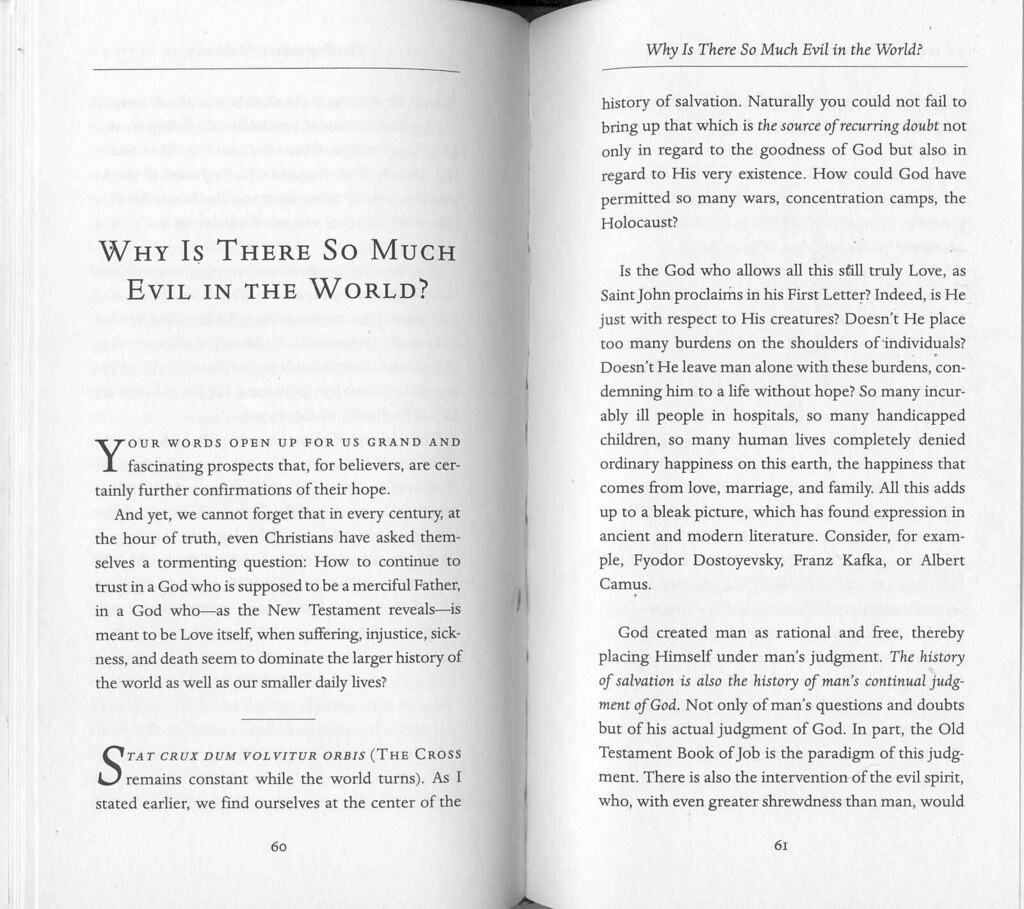
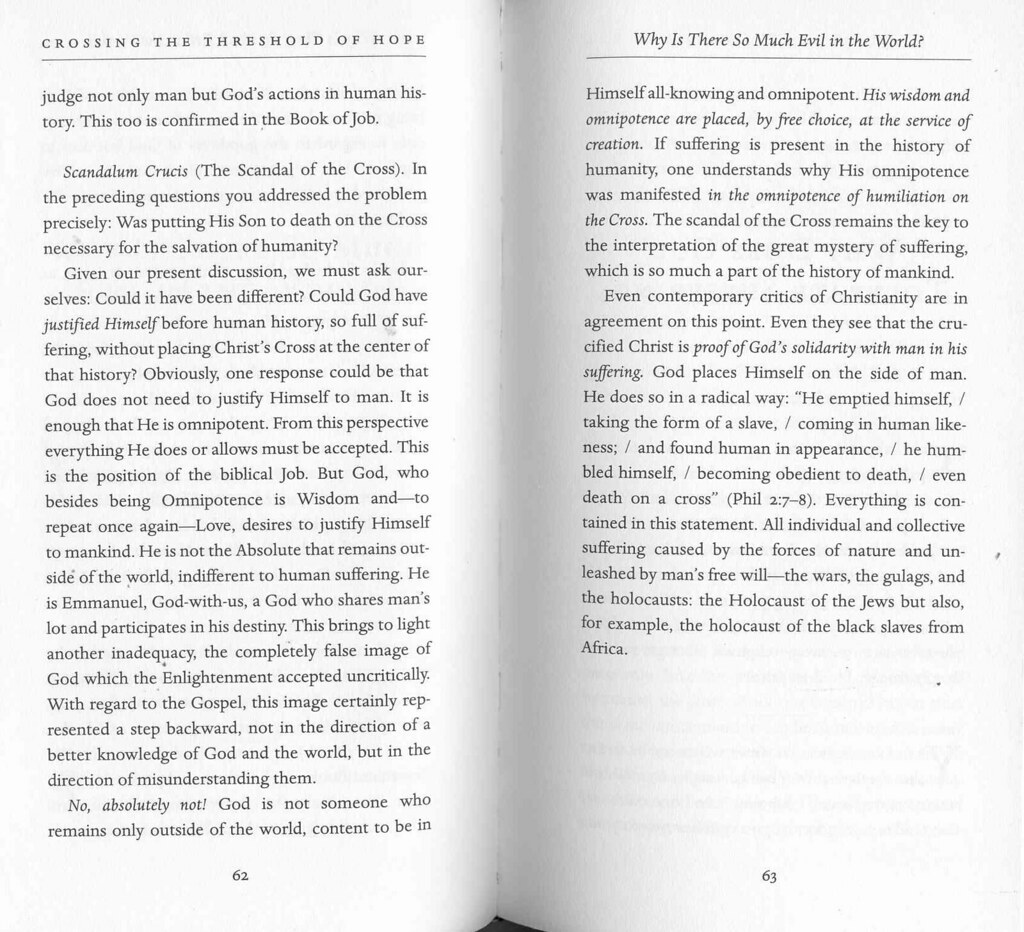
In fact, this is echoed in many other catholic writings. Here’s an example from my library. This is my favorite part of “Crossing the Threshold of Hope” by JPII.

BLOGcrossingthethresholdofhope1


BLOGcrossingthethresholdofhope2


I recommend the whole book, by the way, both because it’s quite good on its own and because, for those that have never read anything by JPII or seen him speak in person; it captures one of the reasons for his runaway popularity, especially among the young. It’s also a short read – 230 or so pages.

The book is the result of a journalist sending him some questions that were supposed to be in preparation for a televised interview. The journalist, who also wrote the Ratzinger Report, didn’t expect to hear back from John Paul II after the project fell through due to scheduling problems and other things that came up for the Pope in September 1993. However, a couple months later, a hand-written manuscript arrived. The book is the product of that manuscript.

When I first read it, I was really surprised, since at that point in my experience I did not expect to see the “God has a lot of explaining to do” sorts of sentiments expressed by, say, a pope. The rest of the book would be about as good, with excellent but short and accessible discussions of a wide variety of subjects.

So, God created man as rational and free and therefore placed Himself under man’s judgment. God’s wisdom and omnipotence are placed, by free choice, at the service of creation. Man has the right to act in conscience and in freedom so as personally to make moral decisions. You are, essentially, called to be accountable to yourself. You are not to abdicate this responsibility to anyone else.

Catholicism, along with many other faiths, is not a passive reception of Truths dictated by old men in vestments once a week in dusty buildings. While it can deteriorate into this, and while this is more than enough to satisfy some (most?) people, it is not what you find in the catechism, nor when you scratch the surface of the church and start asking (undeterred) questions. Sure, some church members (or teachers or officials) might be uncomfortable. Sure, you might run into some static from people that should know better. However, it is your responsibility to apprehend what’s easily available to you, regardless of whether you are a skeptic, an atheist, someone disillusioned, or an interested believer.

On to the question of salvation and belief. This necessitates defining “what it is that saves you”. There are three basic tenets of the Protestant/Catholic Faith/Works schism that played out over the various Reformations and Counter-Reformations. It’s really interesting history to read, by the way, if you aren’t familiar with the era.

1. Sola Scriptura (“Bible Alone”)

There is an old quote: “The Bible, the whole Bible, and nothing but the Bible, is the religion of Protestants.”

This is different in Catholicism, where the bible, church traditions, writings, letters, encyclicals, and other stuff forms a big ol’ blob of “official writings”. A Protestant would (justifiably so, to him or her) hold up the bible and say “No way man, this is the only infallible document.” I happen to fall into the Catholic camp. I think that the Bible is a place to start. However, due to translation issues, figurative speech, and general incompleteness and corruption due to it being written by humans, and due to the fact that I’m a nerd, I give tremendous and equal value to thoughtful philosophical church writings such as encyclicals and other works. I simply prefer and trust a body of work done by a diverse set of people over time, rather than one particular document, no matter how good that one particular document is.

Read “The Wisdom of Crowds” for a contemporary explanation that precisely sums up why I feel this way.

I don’t have any particular argument with or animosity for those that follow Sola Scripture. I don’t think that Sola Scripture the way to pursue a faith life, but if it works for you, then it works for you. You don’t have to agree with but you should definitely respect the honestly-chosen postulates that a person selects for their personal philosophy.

2. Sola Fide ("Faith Alone")
A central principle of the Reformation is salvation by faith alone. The sinner is righteous before God solely on the ground of the merits of Christ as believed in through a faith, in opposition to the theory of the (catholic) Council of Trent, which makes faith and good works equal sources of salvation, with works getting slightly more emphasis than faith. Being Protestant doesn’t mean that you can’t or shouldn’t do good works, but it flatly denies their value as sources or conditions of salvation. In other words, you can be a Secular Humanist, and do good works, and a Protestant will still say you are going to go to hell because you don’t “have faith”. Protestants often criticize Catholicism for allowing people to “work their way” to heaven through good works, or for being “too soft” on those dastardly Secular Humanists who have come to do good works through an introspective process of their own.

3. Priesthood of All Believers
Protestants commonly believe that there exists a priesthood of all believers. This stems from a (understandable) rejection of corrupted church hierarchy in the 1400s. However, since no two people think exactly alike on any subject, this makes for a fractured church situation, which is easily seen in reality. From a purely pragmatic viewpoint, membership in the priesthood can’t easily be universal without suffering tremendous communications overload and balkanization. Worst case? Everyone goes their own way, or one step better you have literally thousands of 100-member churches each churning away in relative isolation. This is, largely, the condition in my native South.

So, can you be saved by works alone?

From the Council of Trent:
“For faith, unless hope and charity be added thereto, neither unites man perfectly with Christ, nor makes him a living member of His body. For which reason it is most truly said, that Faith without works is dead and profitless;"
In other words, we don’t care how pious you think you are, if you don’t actually get out there and do some good, your Faith is pointless. Ouch.

Ok, what if you just do good works and don’t want to mess around much with that Faith issue?

Again, Council of Trent:
“And whereas the Apostle saith, that man is justified by faith and freely, those words are to be understood in that sense which the perpetual consent of the Catholic Church hath held and expressed; to wit, that we are therefore said to be justified by faith, because faith is the beginning of human salvation, the foundation, and the root of all Justification; without which it is impossible to please God, and to come unto the fellowship of His sons: but we are therefore said to be justified freely, because that none of those things which precede justification-whether faith or works-merit the grace itself of justification.”
The short answer is no, good works alone won’t save you. It’s handled in the first canon of the Council of Trent.
CANON I.-If any one saith, that man may be justified before God by his own works, whether done through the teaching of human nature, or that of the law, without the grace of God through Jesus Christ; let him be anathema.
You are going against the theme of Catholicism here, in other words. This is understandable, since having faith (no matter how simple or how complex, how strong, or how weak) is kind of central to Christianity. However, as I mentioned before, faith alone won’t do the trick either.

CANON IX.-If any one saith, that by faith alone the impious is justified; in such wise as to mean, that nothing else is required to co-operate in order to the obtaining the grace of Justification, and that it is not in any way necessary, that he be prepared and disposed by the movement of his own will; let him be anathema.


Catholicism and Secular Humanism overlap here (good works: check! Faith: possibly a problem…), where Protestantism and Secular Humanism are completely disjoint (you’re going to hell!). Many Secular Humanists are publicly atheist or agnostic while having a private faith life. If you differ with the assumption that Secular Humanism requires personal atheism, then the path to Council-of-Trent-style Justification is cleared.

Catholicism doesn’t let you either force or prevent someone from acting either contrary to or in violation of his or her conscience, especially concerning religion. So, in the case of someone that is totally convinced they’re a Secular Humanist, and that person is obviously doing good works, then feel free to challenge them to develop a faith, but in matters of conscience, you are not to force them or prevent them from practicing their own faith tradition.

It might seem odd for me to refer to Secular Humanism as a faith tradition, but to me it qualifies. Secular Humanism can be and is defined as a religious worldview based on naturalism, atheism, the primacy of the scientific theory of evolution, and moral relativism. Secular Humanism produces good work and good people, who are all on various paths of discovery about the good, the true, the beautiful, and all other aspects of life that interest humans.

To me, Secular Humanism simply duplicates much of the same sort of results of many religious faiths. It simply starts at a different point further down the pipeline. I don’t have any particular complaint with Secular Humanism except for the problems that are often encountered with moral relativism and the tendency towards materialism. These problems are significant and widely discussed in both religious and secular humanist circles, but are an area of active ethical and philosophical Secular Humanist research. In other words, they’re working on it, so people should stop portraying Secular Humanism as unethical selfish heathens because that simply isn’t true.

A vigilant Secular Humanist will be no more susceptible to failures in morality due to relativism than someone that ascribes to a different worldview. A thoughtful Secular Humanist will be no more susceptible to decadence and materialism than the typical Californian, and possibly quite less.

If you develop a system of belief that guides your behavior, then you are acting in good conscience. Your salvation as a Secular Humanist, according to Catholic doctrine, may not be complete, but you have one foot in the door already.

This begs the question, though – if a Secular Humanist acts in accordance to a moral code that is identical, to say, a Catholic moral code, even though the morals appeared to come from different sources, is the Secular Humanist really a Secular Humanist? Or are they a parallel-universe Catholic? Could God simply be Reason? Could Reason simply be God? Sure, if you have a universalist attitude.

If God can be or do anything, then a facet of God can easily be “Reason”. The invitation to use Reason for Good is issued by God. The rest is up to you.

I prefer to view Secular Humanists as brethren. Perhaps God reaches them in a different way to accomplish the same result – good works done just because good works are the calling of humanity. Maybe some people need fear or a threat of hell (ick). Maybe some people need to feel the solidity of a floor of reason beneath their feet and distrust the non-experiential. Perhaps some people need Zeus, or Peyote, or the Spirits of the Ancestors, or Mother Earth. I really don’t care, as long as the motivation is to do good.

Finally, having faith doesn’t mean you don’t have doubt. “A faith” in something is accepting something without proof. “Having faith” is the process of developing a faith life. They are not the same. “A Faith” is a static and one-dimensional time-invariant statement. “Faith” as in faith in God is a continual process which requires the constant evaluation and growth of the self and does not mean that you have all the answers at any one time, if ever. It isn’t something that’s inherent. It’s learned.

“Having faith” is different for each person. For me, it’s the productive contemplation of the mysteries encountered in life, philosophy, and nature. For other people, it’s a personal relationship with God developed through prayer. For others, it may be the examination of theology and the development of religious thought. For some people, it’s all of this and more.

We’re all guilty of this (deferring to the experts) in at least some aspects of life. In a very specialized society, you will not be able to master everything you need in order to make decisions throughout your life. You save your energy for the big ticket items, like your health care, or your chosen career, or your personal moral code. Some people are totally ok and experience a resonance with a moral code (or religious values) being taught to them in toto as dogma. It works for them, and they go with it. They’re low maintenance. I’m not. Most people I know are not, either, preferring to do the hard work of figuring stuff out on their own, often in the face of people that don’t understand what we’re all about. To them, we’re spending a lot of time re-tracing old ground. However, in my case, I needed to do the work myself, and didn’t like simply accepting what I was being taught.

Fortunately, and like most but not all of my compatriots, I was encouraged to explore and experience by church members. I wasn’t condemned or yelled at or threatened in any way shape or form. Sure, I was challenged, but I took it on as a challenge, and it was definitely worth all the reading and thinking and distancing myself from religion that I did.

About Criticizing Religion - a Postscript

Statements about religion such as “it’s the opiate of the masses” or “obviously nothing more than a method of social and political control” or “nothing more than a dictatorship with good music” assume that religious people are mindless zombies that can’t think for themselves. This is nothing more than snobbish bigoted tripe.

It’s as bad as saying gay people are inherently and inescapably promiscuous or Secular Humanists can’t be trusted because “they don’t buh-LIEVE in the al-MIGH-ty GAWD”.

Catholics, etc. are obligated through free will to develop a faith life in good conscience. Some are better at it than others, but there are literally millions of non-religious people that seem to not want to think for themselves either, easily fall prey to social and political control mechanisms, and don’t even have good music.

Churches are communities of people. People are subject to critique. Productive critique is welcomed. The goal of a critique is to communicate possible errors, shortcomings, or failures. Using pejorative language or making sweeping and negative generalizations right off the bat generally isn’t the hallmark of constructive criticism. It has the additional unfortunate effect of ensuring that the subject or audience of an otherwise valuable critique will immediately discard whatever follows as bigoted.

This makes religious people no different than other types of people. The rules of civil discourse shouldn’t change just because people identify as a member of a religious faith, philosophy, orientation, or creed. Save the snide comments for sitcoms and satires, where we can all then enjoy them… as God intended.

(hehe, sorry I couldn’t resist)

-Michelle Thompson 21 March 2006

Tuesday, March 14, 2006

Winter Storm on Palomar Mountain, Ham Radio Class, and Repeater Site Hike-in

Tuesday 7 March 2006 Spent wonderful day at zoo, then model railroad museum, then plant pavilion. Took lots of photos, using the telephoto lens at the zoo and the macro lens at the railroad museum and plant pavilion. Geneva had a close encounter with a Peacock and we took the SkyFari ride, which is a small gondola, from the back of the park to the front. I can't walk very far, so this was a "shortcut". The kids had never been on it. Michael immediately named it SkyFerrari, and realized that everything in view was the zoo, and that it really was a very big place.


We took a lot of photos. Here's the set.


Thursday 9 March 2006 We spent entire day at Disneyland with extended family. Geneva, who loves princesses, was in pretty pink princess heaven. There was a princess castle, princesses walking around, and a fairy godmother at breakfast!


P3080018


We got a family photo taken!


Disneyland20061


Note the cute Tinkerbell.


I took it easy, I checked into the Disneyland Repeater, I monitored APRS in the area, and generally geeked out while everyone rode rides and saw shows.


The day went really well until I got a very strange phone call from the Palomar Mountain Observatory. This needs a bit of explanation. I organized a ham radio class for the mountain, mainly to serve the volunteer fire department, but also including anyone else that wanted to become a ham. I had reserved the rec center at the observatory since it had a place that most resembled a classroom. This was back on the 24th of February. The class was scheduled for the 11th and the 18th of March.


On the 24th February, a meeting to finalize the reservation was set up for 2pm on Sunday, February 26th. Later that day, the secretary wrote me back and postponed the meeting due to "unforeseen circumstances". I didn't inquire what the circumstances were. I thought maybe illness or accident or else the staff was busy. I hoped that the "unforeseen circumstances" didn't involve anything too seriously bad.


I was told by the secretary I'd been working with (a very professional and courteous person) to wait for a call in order to set up a meeting for the week of March 6th. No one called the next week, so I wrote the secretary back on the 8th of March asking if the meeting was still necessary, and whether or not a phone call would do.


So, since I was expecting a call anyway from the observatory about the reservation of the room, I didn't think much of it. I took the call, and greeted the fellow with "It's great to hear from you!" The reply was "Well, we'll see about that."


How odd, I thought. The next ten minutes were comical, to say the least. I was berated, belittled, interrupted every single time I tried to speak, and even more strange - the guy turned out to not be the guy I was expecting a call from. Instead, this was his supervisor.


He tried his best to bully me and then twice threatened to cancel the reservation. I was accused of taking the observatory for granted and other various vague failures on my part, none of which sounded familiar, since I'd followed all instructions and had a great experience with the observatory staff up until this phone call. I began to wonder if it was an early April Fool's joke. Only thing was that it wasn't really funny.


Since I'd already agreed to meet with anyone at almost any time, and since I'd been told to wait for a call to schedule this meeting, I was kind of confused about this whole conversation.


Being away from my desk (at Disneyland with four small children) this was kind of a surreal moment. It's hard to plan when you don't have your planner, but he refused to let me call him back when I got back to San Diego. I agreed to meet before the class, at 7:30am, just to go over whatever they wanted to go over in using the classroom at the observatory. This, to me, was a somewhat strange request. I'd been completely available for a meeting at any time since the 24th of February, with the exception of late Monday evenings. Why the rush-rush chaos now?


The instructor for the class was set to arrive at 7:45am, and had been willing to meet to finalize the classroom reservation as well. The class was to start at 8:00am. I mentioned that the instructor might be a better person to meet with since he was already going to be there a bit early, and that unleashed another angry outburst from the guy on the phone. I was lectured about how I was the one responsible if for some reason a bunch of volunteer fire department people burned the place down (what a hysterical image), or made a huge mess. Obviously, that suggestion wasn't going anywhere. No matter, I was going to be up there anyway, and meeting at 7:30 vs 7:45 wasn't much of a difference to an early riser like me. I asked him if there was some other issue that was the real problem, but his answer was unclear. Finally he hung up with a BANG. Whew! Weird.


I decided to call the secretary back and ask her if she could give me a better explanation. She had a very interesting story! She said that the person I was organizing the class for (who will be referred to as Happy) had come into the office and put the class on hold, and that he was "going to talk to me about rescheduling it." I told her that was news to me, and that I'd have to ask him about it. I left a voice mail for him to call me back and touch base and enjoyed the rest of the day.


Friday was a great day. I had a doctor checkup, went to the hardware store and got a bunch of raw materials for making wooden toys, had the oil changed in the truck, cleaned the truck for Operation Date Night, called people to do last minute planning for the ham class, and then picked up the kids at preschool at 12:30, had Rubios for lunch, and kept tabs on the weather. A lot of snow was predicted for the mountains. There was debate over how much Palomar, a relatively small mountain in SoCal, was supposed to get. Some predictions said 6 inches. Others, for the San Bernardinos, mentioned a foot or more. Having four-wheel-drive and some experience with driving in the snow gave me the confidence that I would at least be able to get around in any weather. I made sure the instructor wasn't scared away by the weather. His reponse? "They'll have to close the roads to keep me from coming to teach." Right on!


I dorked around with a great software program in the afternoon called Radio Mobile. This was for another mountain project - to get a Traveler's Information Station up and running at the State Park on Palomar. They have the sweetest antenna site, too, so doing the propagation map was just totally fun.


Ken didn't want to go out on Date Night (kids have date night at the gym) so I did some more computer stuff and packed to drive up to Palomar at 9:00pm.


Snow was already falling, and falling down to about 3000 feet. It would eventually fall in San Diego itself, which is a rare event. The only cars I passed were an SDG&E truck (more about that later - this truck was an early harbinger) and a snow plow. The xTerra did great in 4WD-high. No sliding even when the snow got thicker. We couldn't get the gate open at the cabin due to the bottom being already in a foot of snow, but the truck was in the driveway. This was probably not the best place to park it, as I found out the next morning, but it made getting kids and dogs and computers and cameras and clothes inside a lot easier.


UH OH


The cistern at the cabin was empty. This was immediately obvious since the pump was spinning away downstairs, dry. For how long, no one could tell. Ken took the action item to figure it out, since I don't do plumbing. Or windows.


He solved our no water problem by running a hose from the well to the cistern and filling it up that way. It was unclear where the freeze was, but no bursting was apparent. Since it was just under freezing, I didn't expect anything catastrophic. The pipes are below ground, and it had been warm recently.


Now, the interesting thing about Ken is that he really doesn't like microbes. Or toxins. Or no-see-ums of any type. He insisted on using melted and then boiled snow for eating since the hose to get the water to the cistern was now suspect (except apparently for toilets, washing clothes, and washing dishes).


Having drunk from garden hoses all my life, I tried to reason with him, but to no avail. "See how I turned out? I'm FINE!" didn't really make much of a dent in the Impenetrable Fortress of Logic that Ken maintains.


The rest of the day was totally great. It snowed and snowed and snowed and snowed. It was getting deep out there, considering this is San Diego County. The snowflakes were those strange little balls, or bigger crystals, then back to the little balls.


We played, we walked around, I took a few photos, but since it was storming, we mostly stayed in, stayed warm, and read books, putzed around with projects, and did some cooking.


I got up early and looked at the snow. I spent about a half hour trying to get the car dug out, then called the Observatory to see what the status was. I got the guy that I was supposed to meet with originally on the phone. This was pure luck, since I'd called the secretary's desk. It being Saturday, and after a major snow, I wasn't really ambitious about getting through to anyone important. He started in on how I should postpone since the roads were closed to non-residents and the instructor would never get on the mountain in the first place. He was quasi-unpleasant, but I thought that was understandable because there was a ton of snow he had to deal with, and he was going to be busy. I told him I wasn't going to try to get over there at 7:30 if the class was going to be cancelled for the day, and he said he was heading out with a bunch of people to go take care of whatever needed taking care of.


Ken took over Operation Truck Freedom and succeeded. In the process, the North County Times took his photo, thus sealing his fame as "guy stuck in snowdrift tries to free car" forever. I'll try to find the photo. He also attracted the attention of "Happy", who was joyriding in his truck while waiting for Ken to get out of the way so he could plow Birch Hill Road. Ken has all the fun!


So, while all this was going on, I called my friend who was also involved in planning for the ham class, and he suggested redirecting people to the fire station. It's easy to get to, and the students are most likely already there in anticipation of a very busy day. He also said he'd call a contact at the observatory to redirect anyone that showed up at the classroom. I thought that was a great idea, since the guy I talked to probably wasn't going to be available to handle anything extra and getting out of their hair was a good plan.


So, I hiked up to my friend's house at 8:00am. I had the coolest doggie escort ever - he just simply appeared out of the snow. He was a really big dog - sort of wolf-like, very friendly, and stuck with me the entire hike. Here is a photo of him. He belongs to a neighbor.


IMG_45361


It's hard to tell from this photo how truly big this dog is, but look carefully at the photo and how wide the truck tire tracks look in relation to his feet. He easily came up to my hip. He could have knocked me over without much effort. His head was massive, wide paws easily allowing him to cut through the snow. He seemed completely in his element, and hovered around me, nudging my hand and looking at me with big smart doggie eyes.


Once I arrived at my friend's house, my doggie escort dropped me off and took off to walk with someone else further up the road. It turns out, the SDG&E truck I'd passed the previous night had been there to restore my friend's power from a downed limb yanking out their line from their house. SDG&E had showed up within an hour or two and gotten their power back on that night. I looked at all the trees, everywhere, that covered the mountain, and (yet again) had the appreciation that power outages were probably going to be an issue.


I helped dig out my friend's cars, rescued some compost, watched them put chains and cables on their cars, evaluated the trees, met their wonderful bird, helped put a kayak aka "fastest sled on the mountain" on top of a car (a kodak moment for sure) and ate chips. We got down to the main road and arrived at the fire station at 10:00am.


Guess who was there? The instructor, with his old 4WD truck, with chains, and daughter in tow! He was stoked. She was cold. Very cold! It was kind of cold, actually, in the mid-20s. She said she could have gone to the beach today, but thought snow sounded more fun. This is the magic of San Diego County. The beach was sunny and warm, and the ocean is visible - gleaming golden in the distance - from just a few tens of feet away from the fire station. While you're in knee-deep snow. And cold.


When "Happy" saw me, he pulled me aside and told me that there was more to the story than simple crankiness on the part of observatory staff concerning the room reservation. What I heard was amazing. Apparently, someone else who works at the observatory - someone who is also in the ham radio club with me, and has been a bit cranky with me in the past had learned about the ham class room reservation. He is also supervised by the guy that called me while I was at Disneyland, so the connections became clear.


Apparently, this same fellow wanted to put a ham radio class together 5 years ago and it didn't work out. I guess he viewed ham radio classes on the mountain as his turf. Ironically, I'd tried to contact him about helping with the class, and not gotten a response. Since he lives up here, I figured he'd want to help. His view, as told to "Happy", was that he should get to organize the class, and I should handle "overflow". Overflow? Like, in a sewer? Overflow from what? The great pent-up demand to become Amateur Radio Operators? Like being a volunteer firefighter doesn't already mark you as some sort of freak of nature?


Ok, maybe I'm in dreamland, but if there is that much demand that there is overflow, then there will be more ham radio classes in the future and everyone that wants to teach one can. In fact, the instructor of that day's class has been begging for more instructors to teach all over the county.


I offered to "Happy" to let the guy take over the class, even if I had to continue to do the work, if it would make it easier for everyone to get along. It's no skin off my back. "Happy" said it wouldn't be necessary, and to keep doing what I was doing. I agreed with him. I'm thinking that the best thing to do is to just let it go. There's no sense in raising a fuss about someone upset for things I have no control over. Not everyone likes me, and I can't help that. I can only continue to do what I can, where I can, and continue to be civil and cooperative with everyone I work with. That includes everyone at the observatory.


We actually and seriously had a class that day at the fire station and then later at the restaurant. Calls came in all day for the crews, so the instructor focused on teaching the ones that were there so they could train the others. It was under very chaotic conditions with radios blaring and melted snow and boots thumping over the floors, and people talking over each other's heads, and large herds of uniformed folks heading in and out, but it was completely fun and the basics actually got covered - the essential definition of the test, how to approach it, and material for study distributed. We ended the class at about 2:00pm to both give the instructor time to get back down the mountain safely, since the snow was falling heavily yet again, and let the crews go to increasingly numerous calls.


I got a lift back to the house, and spent the rest of the day playing with the kids in the snow. Michael loved it. Geneva got her fill pretty quickly. Her little pink face told me the whole story. "Um, where is my coach? My footman? My warm milk? You mean I actually have to walk through this stuff? I'm going back in to conclave with my PONIES! Thank you very much."


So, she liked looking through the window at Michael playing, much more than actually joining him.


Later on - at 7:33pm to be exact - I was writing an email to a church friend to see if I could get someone else to record mass for me the next day. Chains were required and roads were closed. We were snowed in. At that moment, the power went out. The computer and my cell phone modem were the only things on.


The power did not come back on. I realized that our generator was not taking over. This was bad. The battery in the generator had not been replaced yet, and well - it's kind of necessary. We immediately shut all doors and started a fire in the fire place. It actually kept things really warm. We called it in to San Diego Gas & Electric after noticing the entire side of the mountain was dark. They estimated 12:00am repair time. We could see flashing lights soon at the end of the road and thought that must be a repair truck.


We turned in early, but had to keep the fire going, so it wasn't a solid night's sleep. The power didn't come back on at midnight.


At 7:00am I hiked out to check on things and brought the camera along. I took a lot of photos. The mission was two-fold. I wanted to see if the repeater was on emergency power (CW "P" is added to the ID if it was on emergency power) and if it was, or if it was off-line, then I was going to hike down to the site to do a visual inspection. The repeater came up on emergency power, so off I went.


The walk was really pretty easy, even down the dirt road that hadn't been plowed.


Here is the set of photos from the site. If you saw the video from the other day, then these will be familiar.


Set of all winter storm photos.


The place was totally magically beautiful. There were a lot of limbs down everywhere. I kind of figured that it might take a little longer to get power back on than they thought, especially if whole trees were down back in where the power lines ran.


I hiked back home after taking the scenic route and meeting the same doggie escort from Saturday, still romping around in the snow like there was nothing there. I sent in a report to the radio club board, and answered some other email. We decided to head out in the afternoon since Ken had work on Monday and the power situation would probably not improve. Ken scouted out S6 (South Grade Road) and I packed up and cleaned.


Ken came back with an amazing story. There was a solid line of cars on South Grade Road. It was Deep Impact - the movie grade traffic. Everyone was playing in the snow. Whole families had grills, picnics, wine and cheese parties, shovels and pickup trucks full of snow to drive back down to the city for snowball fights. It wasn't moving. No one was going anywhere.


Since I of course wanted to see this chaos for myself, I said we should of course take South Grade. Ken was up for it, and off we went! The roads were plowed, but still covered in snow, but 4WD-low got us to the main road, and 4WD-high got us down to the traffic jam. We passed one other car. The driver asked me if we'd been down the mountain yet today. The trees were completely encased in gleaming white. The clouds moved back in, and the entire forested mountain-top became an ethereal wood with us moving through the heart of winter.


We made it to the main intersection, then turned onto S6.


Seven miles and 2.5 hours later, we were through what we estimated was over 2000 cars. There were 2WD hondas. There were snowplows, stuck in the traffic. There was a highway patrol car in the middle of it all. There were trucks, racing imports, an armada of minivans packed with kids, and a large bus.


There were people sledding on driveways, in the road, on the road, down what can be only described as cliffs, and across the road. Constant snowballs criss-crossed the sky. There were dogs, people in snowsuits, people in t-shirts, people in jeans. There were kids laughing, crying, and/or staring in shock at this strange white stuff. There was music, laughter, yellling, people trying to direct traffic, people trying to turn around, people spinning out.


It was one of the most bizarre things I have ever seen. And, it was so weird that I didn't take any photos at all. You'll just have to imagine the Rio Carnival - on Ice - mixed with a Street Fair then crossed with a car show.


We made it home with a large amount of snow still on the top of the car. Ken decided to go get some food before it melted, which of course caused people to run into inanimate objects while staring at him in the parking lot.


Listening to the repeater traffic the whole weekend taught me some things. The club and the site are generally pretty prepared, but people tend to pass along stale and incorrect information. People speculate and opine about things that are going on, and it gets assumed to be the real story by people listening, who then pass it on, and it quickly becomes The Truth.


The batteries were rumored to be dead. The power was rumored to be out for over three days when it had been off for less than 30 hours. Emails started zipping around with pointed questions.


I'd already taken site photos, made a couple of reports when necessary, and headed out. I knew this upcoming phase well - and always try to avoid it. There is a time for evaluation and analysis, and now was not it. This was the period in time where the news of an emergency has spread, and everyone has an idea or question on what to do. However, things were already coming back online. However, things were still bad on the mountain for everyone else.


The power had come back on at 1:00am on the 14th of March. 54 hours of outage and the repeater site had done really well, with minimal problems. Sure, the club will take care of the things that failed, but I'm not even going to bother wading in until all the facts are known and people that aren't going to actually do any site work in the future get bored and wander off.


The phones also failed on the mountain, which points to another issue with the communications infrastructure. Our communications group on the mountain will probably get a lot out of this experience, along with the fire department and the community in general. I'll write more as this develops. My cell phone worked for the most part, but coverage is kind of problematic, and in the traffic jam on S6, the cell was obviously overloaded and quit accepting new calls.


SDG&E deserves some remarks here. It's really hard to figure out where the power failed on a mountain, in two feet of snow, with little trails that suffice as roads, where things aren't marked and the snow and the limbs continue to fall. They did a great job repairing things.


So, that was my weekend, guys!

Tuesday, March 07, 2006

Project Tolkien Part One

Project Tolkien Part One

This is a photo of my San Diego Model Railroad Museum floor tile. Installed 2006. Each tile is actually part of a railroad motif that goes down the center of each hallway. There are a couple hundred tiles so far. The museum sells them as a fundraiser. Usually people put their name or a memorial name, or a sponsoring company buys a tile. I'm sure you've seen something similar at universities or other places where donations are important.

The black background is the railroad tie. There's two metal decorative strips for the rails themselves on either side. I forgot to get a hallway-scaled photo, but will get one next time I go, so you can better tell what I'm talking about. Since it's a railroad museum, the tiles form a railroad motif.

Balboa Park 0871

pano1

Sunday, March 05, 2006

A Worthy Opponent

A Worthy Opponent v2.0

This is a portrait of the Violin as opponent instead of as instrument.

Chess is a metaphor for the progression that practice enables. Throughout the long course of learning to play a musical instrument, one can be winning or losing as measured against a benchmark of performance quality that may be set too high or too low. Chess is a game with similar aspects, as an advanced beginner finds out the first "real" tournament they play in.

One can resign the game, or perservere to the end. One can also experience the stalemate of reaching a plateau, unable to progress further.

The colors of music can be considered warm, saturated and/or barely controlled. The emotive aspects of both music and color are universal.

The focus is often on one single brief note at a time. Hence the decisions on the coloration and the attempt at soft focus in the photos.

The setting of the photo is a table and chess board that lives in the closet. The violin is mine.

Yellowstone

Yellowstone National Park is one of my favorite places. You might have read about renewed geothermal activity at the park. The March issue of Nature has an article about how a large blob of the earth within Yellowstone Park has risen over the past five years.

The LA Times reported on March 4th that "The bulge, about 25 miles across, rose 5 inches from 1997 to 2003 and may have triggered some thermal unrest at Norris Geyser Basin, including a sudden rise in temperatures, new steam vents and the awakening of Steamboat geyser, the team reported in the current issue of the journal Nature. It is presumed to be caused by the movement of molten rock."

The Great Falls Tribune reported "Steamboat geyser erupted in May 2000 after nine years of dormancy and then erupted five more times between 2002 and 2003. Porkchop geyser also sprang to life after 14 years of dormancy.

Ground temperatures at Norris, the hottest and most unstable geyser area in the park, rose so high in 2003 that Yellowstone officials closed some boardwalks.

And just north of Norris near Nymph Lake, a series of steam vents churned and emitted white clouds of gas.

Scientists studying the shore of Yellowstone Lake found that the caldera has been rising and falling for at least 15,000 years, sometimes swinging more than 10 feet."

All of this is very exciting, since I studied the various geyser basins before and during my Yellowstone visit, and am very interested in going back again.

Here's a photo of one of my favorite terraces in the park. I remember walking beside the very large and intensely detailed structures and thinking how it looked like it was made from dried egg whites and sugar.


Here's a map of the various calderas in the park. The volcano is one of the largest on the planet, and is 40,000 years past due for an eruption. The last major eruption was 640,000 years ago and was of global significance.


Here's another groovy map of the main caldera. This gives an idea of the size of the volcano. Compare this to the size of Mt. St. Helens.


Image above and text below from livescience.com

"The Yellowstone Caldera. The best estimate of the caldera rim is shown salmon. White arrows show interpreted magma migration paths. The red symbols mark volcanic centers that erupted after the caldera formed 640,000 years ago. The areas of known past or present thermal activity are colored yellow. Credit: R.L. Christiansen/USGS"

Wednesday, March 01, 2006

Retirement

Retirement: Ready or not? Not, apparently

A summit in D.C. considers what can be done to help workers save more for their post-career lives.

By Jeanne Sahadi, CNNMoney.com senior writer
March 1, 2006: 5:21 PM EST

NEW YORK (CNNMoney.com) – This week in Washington, D.C. government leaders, retirement experts and financial services executives are meeting to discuss what employers, lawmakers and workers themselves can do to help Americans be better prepared for retirement.
Ok, I'm with you so far, I think to myself as I'm reading this.

Overall, only about 60 percent of workers over 40 who are eligible to participate in their 401(k)s do, and the number of workers covered by a defined-benefit pension has steadily declined. Meanwhile, young workers have the lowest 401(k) participation rates of all workers under 65.
This surprised me. Of course defined-benefit pension plans have steadily declined in popularity. The increasing complexity of rules regarding funding of pensions, the disadvantages to workers who don't stay with the same organization until retirement, and the looming massive unfunded liabilities that many of these pensions face are all reasons that many places have switched to defined-contribution plans. While defined-contribution plans have their own challenges, they are quite popular with workers. The portability of most plans is very useful to those of us that will probably work for seven or more places in our work lives and change careers at least once before retirement.

The fact that 40% of eligible people don't participate in a 401k actually shouldn't surprise me. The U.S. savings rate is quite low. It appears negative in most studies, meaning we spend more than we take in. The reason for this extra-low savings rate is that the U.S. government savings rate calculations don't include home appreciation and capital appreciation. In other words, think of all those home mortgage refinancing advertisements and stock portfolios. However, even including these things, the savings rate is still worryingly low.

Congress is considering legislation that would encourage all employers to offer automatic enrollment in 401(k)s and set the default contribution rate at 3 percent of pay, increasing one percentage point every year until 6 percent of pay is reached.
"Encourage" employers? That's an odd choice of wording. Usually legislation mandates something. "Encouragement" sounds toothless.

Also, 3-6% isn't really that much. 3% of 50k is only $1500 a year. OK, it's something, but it's not much, especially when you look at how much you're allowed to contribute per year to your 401(k) and IRAs.

For 2005, the maximum allowable annual contributions for traditional and Roth IRAs were $4,000. For 401(k) plans, the maximum is $14,000 in a year. Both allow special catch-up contributions for people age 50 and older. For 401(k) plans, the catch-up is an additional $4,000 (for a maximum of $18,000). For IRAs, the catch-up contribution is $500 (for a maximum of $4,500). So, what's the real reason for not maxing out our contributions every year? There really isn't one, considering the huge tax savings that these plans offer, and how really cruddy it can get on a fixed income when you don't want to or can no longer work.

The legislation would also encourage companies to offer a 50 percent matching contribution or contribute 2 percent of pay for all employees whether they contribute or not.
There's that "encourage" word again. Unless it's mandated, most businesses, especially small ones, will continue to do whatever they do.

Of most immediate concern is the status of Baby Boomers, who are next in line to retire.

According to research from Fidelity Investments, Baby Boomers only have enough in savings and other income sources to replace 59 percent of their pre-retirement income. Of those with 401(k) accounts, the average account balance is just $80,000, and many typically save just $2,750 a year toward retirement.
That's just plain sad. $80,000 on average means half have saved more, but half have saved less. $80,000 doesn't go very far if you live another 20 years after retirement. 59% of pre-retirement income may suit many people just fine, though. Working consumes money to make money. You have transportation and clothing and other expenses. It's never made 41% difference in my working years, but maybe it does for people that actually had to look presentable at work, and drove more than 9 minutes to get to their office.

Of course, baby boomers were the last ones to get all those great pensions, so surely they're covered in other ways.

You may think that's because they all have a pension coming to them. Not so. Only 57 percent of them expect to receive a pension, according to Fidelity.
Doh! Now it's not just sad, but inexplicable.

For those who do and who wish to reduce their working hours near the end of their careers, lawmakers are considering changing some rules so that workers could "phase in" their retirement, for example working part-time for their employers from 62 to 65 and collecting a portion of their pension at the same time.
I like the plan where I can phase in my retirement from the start. Like, can I get a gold watch and a party on my first day?

A Watson Wyatt analysis found that a 62-year-old worker making $100,000 could generate between $10,000 and $20,000 more in pre-tax income under such an arrangement than if he entered full retirement at 62 and collected his full pension.

Currently, regulations often prevent most workers from collecting benefits while still working for the company providing their pension.

For workers under 50, the chances of having a pension are declining. Since 1980, the percentage of private sector workers covered by defined-benefit pensions has fallen from about 35 percent to under 20 percent.

And tens of thousands of workers have learned in the past two years that their companies are freezing their pension plans, meaning the workers will no longer accrue benefits and will need to save more to make up for lost accruals.

To help educate the public about what they will need to do to adequately fund their golden years, the Department of Labor, which is sponsoring this week's retirement summit, has just published a booklet called Taking the Mystery Out of Retirement Planning.


Well, there really is no mystery. Delayed gratification can be hard.

You might have to give up some "stuff" to save for retirement. Running the numbers on even the most rudimentary internet calculator, and taking to heart the lessons of others that have had pension and 401(k) problems is another eye-opening responsibility. It's amazing how much money you need just to meet the average needs of an average lifespan in an average cost-of-living area. I didn't have nearly an appreciation for the amount of money needed for retirement until actually running the numbers using some planning spreadsheets.

Things worth doing are rarely easy, and most people just don't think a lot about the future. The only trouble is, the future is inevitable, and people aren't saving nearly enough. It's not that hard if you make it a priority, but it's hard to hear the message through all the noise.

How Times Have Changed - Patrick Henry to Jim Bunning

"It is in vain, sir, to extenuate the matter. Gentlemen may cry, Peace, Peace-- but there is no peace. The war is actually begun! The next gale that sweeps from the north will bring to our ears the clash of resounding arms! Our brethren are already in the field! Why stand we here idle? What is it that gentlemen wish? What would they have? Is life so dear, or peace so sweet, as to be purchased at the price of chains and slavery? Forbid it, Almighty God! I know not what course others may take; but as for me, give me liberty or give me death!" Patrick Henry, March 23, 1775.

"Civil liberties do not mean much when you are dead," Sen. Jim Bunning, R-Kentucky, Wednesday, March 1, 2006