Wednesday, January 26, 2005

Sewing Project Update 1: The Chrysanthemum Burnoose
This sewing project went very quickly. I cut out, assembled, and finished this Burnoose in one afternoon.
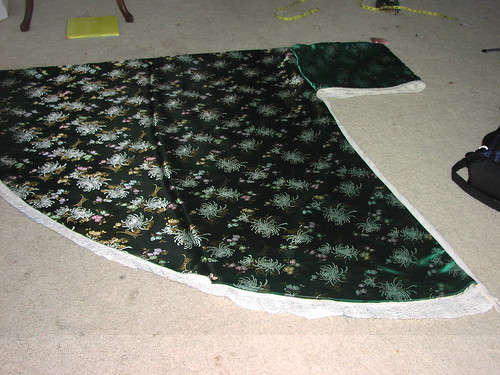
All of the things I noted from working through The Ranger Burnoose were appllied here. The project went much faster due to having some experience with the design. I used the same pattern as before, which can be found in the Folkwear book.
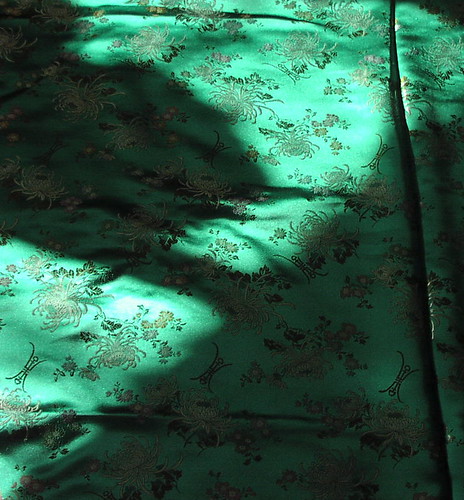
The green outer fabric is a "silky brocade" (55% nylon, 45% polyester). It has a design dominated by Chrysanthemum blossoms.
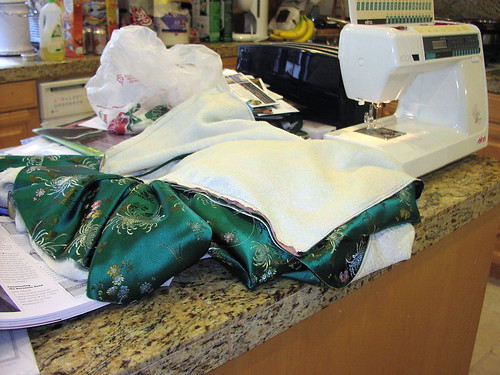
The white lining is a polyester-type heavily textured fabric with about the same stretch as the brocade. The binding is quilt binding in green and white. The fabrics stitched together very easily even though they are both fairly heavy in weight.
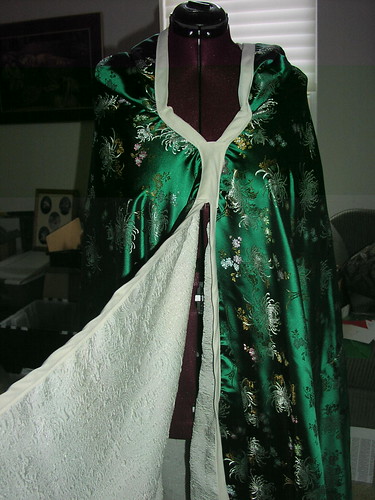
The tassel is pink. There are pink accents in the green brocade. Initially, I had selected several pink fabrics for the lining, but this particular green brocade has some blue in it. The pink against the green made the green look muddy, but a very light cream white didn't give the same effect and the pink accents still stood out. The pink tassel provided more than enough coordinating accent color.
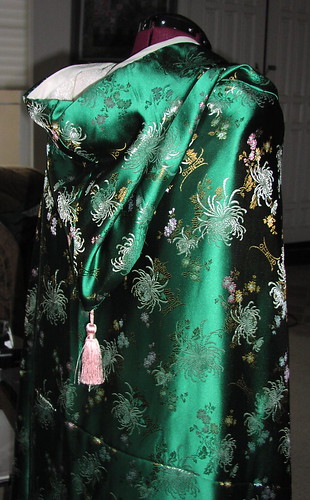
All of the things I noted from working through The Ranger Burnoose were appllied here. The project went much faster due to having some experience with the design. I used the same pattern as before, which can be found in the Folkwear book.
The green outer fabric is a "silky brocade" (55% nylon, 45% polyester). It has a design dominated by Chrysanthemum blossoms.
The white lining is a polyester-type heavily textured fabric with about the same stretch as the brocade. The binding is quilt binding in green and white. The fabrics stitched together very easily even though they are both fairly heavy in weight.
The tassel is pink. There are pink accents in the green brocade. Initially, I had selected several pink fabrics for the lining, but this particular green brocade has some blue in it. The pink against the green made the green look muddy, but a very light cream white didn't give the same effect and the pink accents still stood out. The pink tassel provided more than enough coordinating accent color.
Tuesday, January 25, 2005
Sewing Project Update 1: Play Mat and Snake
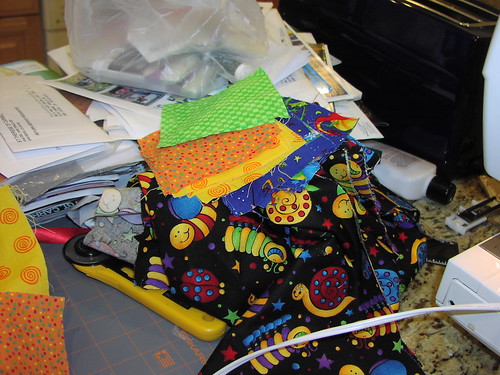
All the pieces, ready to be sewn together.
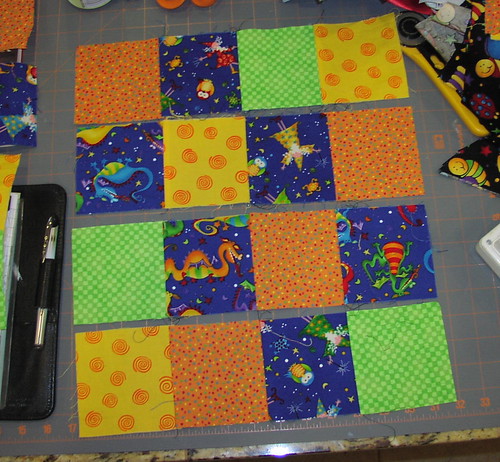
Trying out different arrangements for small play mat.
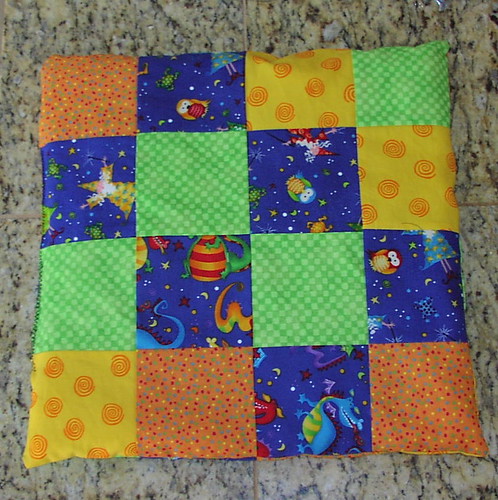
Constructed play mat. It's about 18" x 18"
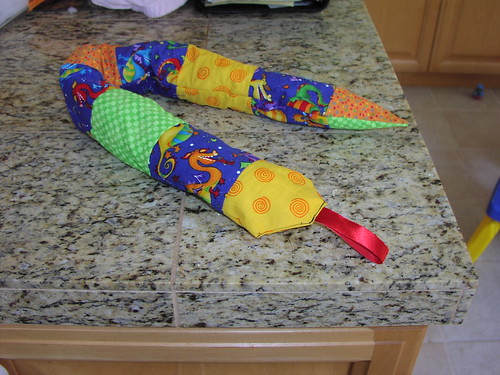
Small stuffed snake to go with play mat.
Sewing Project Update 6 (final): Tibetan Panel Coat
Tibetan Panel Coat Completed tonight around 7pm.
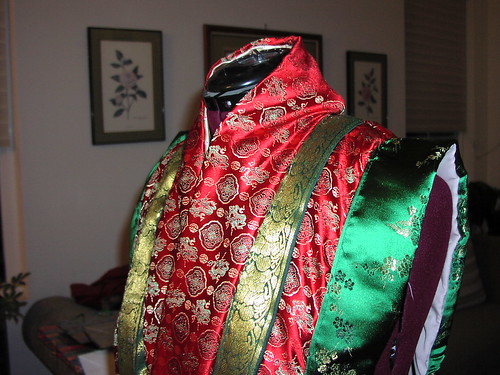
There are some flaws. The side vents have a disparity between the lining and the outer layers which causes the sides to not lie completely flat.
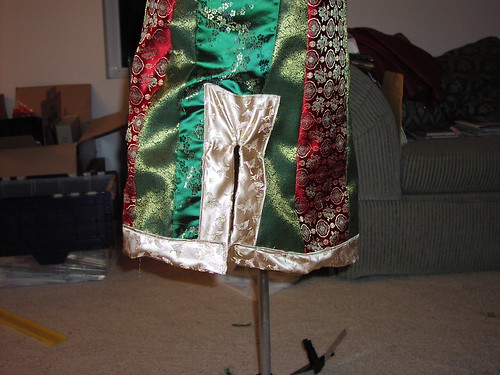
The decorative shoulder facing on one side is more wrinkled than the other. My seam ripper got a workout today because I failed to read through the directions as well as I should have. Other than those things, the project turned out as pictured! It was fun and I am plotting the next panel coat.
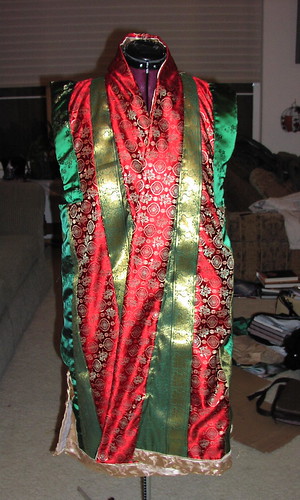
Panel coats are similar to swing coats or pea coats in the way they hang and wear. They are narrower than the aforementioned styles, but the general shape is of a swing coat.
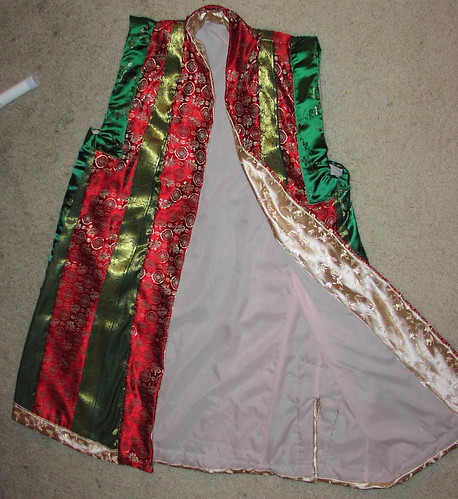
Here's a full-length view.
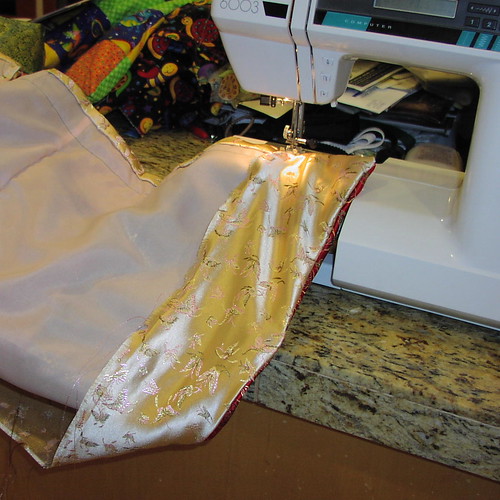
Here is one of the final seams going in.
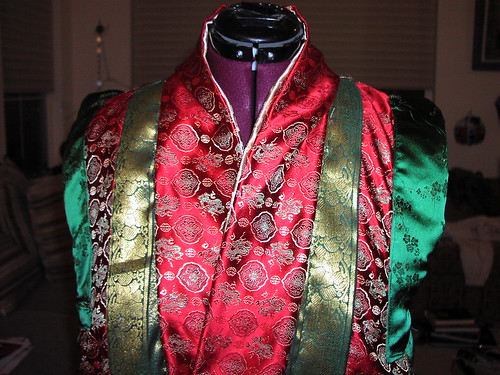
This is a view of the collar facing.
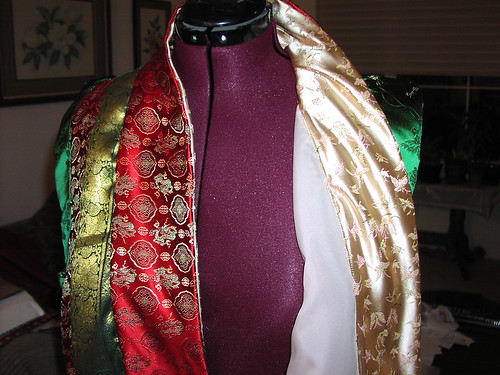
There are some flaws. The side vents have a disparity between the lining and the outer layers which causes the sides to not lie completely flat.
The decorative shoulder facing on one side is more wrinkled than the other. My seam ripper got a workout today because I failed to read through the directions as well as I should have. Other than those things, the project turned out as pictured! It was fun and I am plotting the next panel coat.
Panel coats are similar to swing coats or pea coats in the way they hang and wear. They are narrower than the aforementioned styles, but the general shape is of a swing coat.
Here's a full-length view.
Here is one of the final seams going in.
This is a view of the collar facing.
Best of San Diego
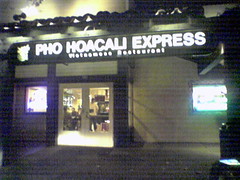
Pho Hocali Express on Mira Mesa Blvd. is my favorite vietnamese food restaurant in San Diego, CA.
Sunday, January 23, 2005
Testbed inteferometer
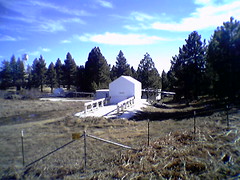
Testbed inteferometer located right outside 200 inch dome on Palomar Mountain.
Poster
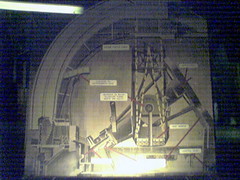
Diagram in Palomar Mountain 200" telescope observatory visitor's platform. Telescope is behind the poster, in the darkened dome, and was too large to photograph very well with the camera phone.


Wednesday, January 19, 2005
Carry On!
"It isn't the mountain ahead that wears you out; it's the grain of sand in your shoe." - Robert W. Service
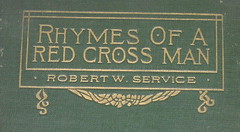
My favorite poem by Robert W. Service is Carry On. It's from Rhymes of a Red Cross Man.
It's easy to fight when everything's right,
And you're mad with the thrill and the glory;
It's easy to cheer when victory's near,
And wallow in fields that are gory.
It's a different song when everything's wrong.
When you're feeling infernally mortal;
When it's ten against one, and hope there is none,
Buck up, little soldier, and chortle;
Carry on! Carry on!
There isn't much punch in your blow.
You're glaring and staring and hitting out blind;
You're muddy and bloody, but never you mind.
Carry on! Carry on!
You haven't the ghost of a show.
It's looking like death, but while you've a breath,
Carry on, my son! Carry on!
And so in the strife of the battle of life
It's easy to fight when you're winning;
It's easy to slave, and starve and be brave,
When the dawn of success is beginning.
But the man who can meet despair and defeat
With a cheer, there's the man of God's choosing;
The man who can fight to Heaven's own height
Is the man who can fight when he's losing.
Carry on! Carry on!
Things never were looking so black.
But show that you haven't a cowardly streak,
And though you're unlucky you never are weak.
Carry on! Carry on!
Brace up for another attack.
It's looking like hell, but -- you never can tell:
Carry on, old man! Carry on!
There are some who drift out in the deserts of doubt,
And some who in brutishness wallow;
There are others, I know, who in piety go
Because of a Heaven to follow.
But to labour with zest, and to give of your best,
For the sweetness and joy of the giving;
To help folks along with a hand and a song;
Why, there's the real sunshine of living.
Carry on! Carry on!
Fight the good fight and true;
Believe in your mission, greet life with a cheer;
There's big work to do, and that's why you are here.
Carry on! Carry on!
Let the world be better for you;
And at last when you die, let this be your cry:
Carry on, my soul! Carry on!
A short biography and an *excellent* photo of Robert W. Service can be found here.
This poem, as with almost all poetry, really, should be read out loud. The turns of phrase, the pacing, and the subject matter (courage as grace under fire, the ability to choose to be bigger than our destiny, etc) are so very good.
It's easy to become melodramatic, dark, or maudlin when writing about war, violence, struggle, despair, and our relationship to nature. However, Service handles what it means to be human in his writing with such an unflinching, honest, and artistic eye that when you read his work, there is a feeling of transparency and immediacy that is almost unparalled in poetry.
"infernally mortal"
"You haven't the ghost of a show"
"When the dawn of success is beginning"
The arc from self/soldier, to son, to old man, to soul is good too. I like the way the use of the passage of time reinforces the idea that struggles aren't just limited to a particular battle or even a particular war. Fighting the good fight is a daily choice. Service was not one to glorify war, but he didn't paint warfare or the struggle with/against nature as entirely brutal, either.
Here's a bit from Time Magazine's archives. It's the beginning (free) portion of a book review from 1945.
"Books
Rhyming Was His Ruin
Oct. 1, 1945
PLOUGHMAN OF THE MOON — Robert Service— Dodd, Mead ($3.50)."I was always in love with rhyme," confesses Robert Service. "If two lines could be made to clink it seemed to go a long way to justify them. . . . Rhyming has my ruin been. With less deftness I might have produced real poetry." Many a middle-aged American would not trade The Shooting of Dan McGrew or The Cremation of Sam McGee for all the "real poetry" in the language. Robert W. Service rarely shows up in the better anthologies or in college English courses. But in money-talking terms of copies sold, he is a..."
If you are a Time magazine subscriber, or have a few dollars to spend on getting the article, the link is:
http://www.time.com/time/archive/preview/0,10987,776216,00.html
Another Robert W. Service inspired work of art is an album by Country Joe McDonald. Here's a blurb about it and the song list.
"COUNTRY JOE MCDONALD, WAR-WAR-WAR
Composed by Country Joe McDonald from the poems of Robert W. Service. music copyright by Joe McDonald Music Corp., BMI 1971. Produced by Country Joe McDonald, recorded at Vanguard 23rd Street Studio, New York, engineered by Jeff Zaraya, cover produced by Robin Menken, cover by Thut-Wainwright, San Francisco, California. Note: all songs about WWI except The March Of The Dead which is about The Boer War.
LP Vanguard VSD-79315
Side 1
Part One
1 Forward 4:39
2 The Call 2:35
3 Young Fellow, My Lad 3:47
4 The Man From Aphabaska sic (Athabasca)
Side 2
Part Two
1 The Munition Maker 4:22
2 The Twins 1:53
3 Jean Despres 9:48
Part Three
4 War Widow 2:02
5 The March Of The Dead 6:27"
My favorite poem by Robert W. Service is Carry On. It's from Rhymes of a Red Cross Man.
It's easy to fight when everything's right,
And you're mad with the thrill and the glory;
It's easy to cheer when victory's near,
And wallow in fields that are gory.
It's a different song when everything's wrong.
When you're feeling infernally mortal;
When it's ten against one, and hope there is none,
Buck up, little soldier, and chortle;
Carry on! Carry on!
There isn't much punch in your blow.
You're glaring and staring and hitting out blind;
You're muddy and bloody, but never you mind.
Carry on! Carry on!
You haven't the ghost of a show.
It's looking like death, but while you've a breath,
Carry on, my son! Carry on!
And so in the strife of the battle of life
It's easy to fight when you're winning;
It's easy to slave, and starve and be brave,
When the dawn of success is beginning.
But the man who can meet despair and defeat
With a cheer, there's the man of God's choosing;
The man who can fight to Heaven's own height
Is the man who can fight when he's losing.
Carry on! Carry on!
Things never were looking so black.
But show that you haven't a cowardly streak,
And though you're unlucky you never are weak.
Carry on! Carry on!
Brace up for another attack.
It's looking like hell, but -- you never can tell:
Carry on, old man! Carry on!
There are some who drift out in the deserts of doubt,
And some who in brutishness wallow;
There are others, I know, who in piety go
Because of a Heaven to follow.
But to labour with zest, and to give of your best,
For the sweetness and joy of the giving;
To help folks along with a hand and a song;
Why, there's the real sunshine of living.
Carry on! Carry on!
Fight the good fight and true;
Believe in your mission, greet life with a cheer;
There's big work to do, and that's why you are here.
Carry on! Carry on!
Let the world be better for you;
And at last when you die, let this be your cry:
Carry on, my soul! Carry on!
A short biography and an *excellent* photo of Robert W. Service can be found here.
This poem, as with almost all poetry, really, should be read out loud. The turns of phrase, the pacing, and the subject matter (courage as grace under fire, the ability to choose to be bigger than our destiny, etc) are so very good.
It's easy to become melodramatic, dark, or maudlin when writing about war, violence, struggle, despair, and our relationship to nature. However, Service handles what it means to be human in his writing with such an unflinching, honest, and artistic eye that when you read his work, there is a feeling of transparency and immediacy that is almost unparalled in poetry.
"infernally mortal"
"You haven't the ghost of a show"
"When the dawn of success is beginning"
The arc from self/soldier, to son, to old man, to soul is good too. I like the way the use of the passage of time reinforces the idea that struggles aren't just limited to a particular battle or even a particular war. Fighting the good fight is a daily choice. Service was not one to glorify war, but he didn't paint warfare or the struggle with/against nature as entirely brutal, either.
Here's a bit from Time Magazine's archives. It's the beginning (free) portion of a book review from 1945.
"Books
Rhyming Was His Ruin
Oct. 1, 1945
PLOUGHMAN OF THE MOON — Robert Service— Dodd, Mead ($3.50)."I was always in love with rhyme," confesses Robert Service. "If two lines could be made to clink it seemed to go a long way to justify them. . . . Rhyming has my ruin been. With less deftness I might have produced real poetry." Many a middle-aged American would not trade The Shooting of Dan McGrew or The Cremation of Sam McGee for all the "real poetry" in the language. Robert W. Service rarely shows up in the better anthologies or in college English courses. But in money-talking terms of copies sold, he is a..."
If you are a Time magazine subscriber, or have a few dollars to spend on getting the article, the link is:
http://www.time.com/time/archive/preview/0,10987,776216,00.html
Another Robert W. Service inspired work of art is an album by Country Joe McDonald. Here's a blurb about it and the song list.
"COUNTRY JOE MCDONALD, WAR-WAR-WAR
Composed by Country Joe McDonald from the poems of Robert W. Service. music copyright by Joe McDonald Music Corp., BMI 1971. Produced by Country Joe McDonald, recorded at Vanguard 23rd Street Studio, New York, engineered by Jeff Zaraya, cover produced by Robin Menken, cover by Thut-Wainwright, San Francisco, California. Note: all songs about WWI except The March Of The Dead which is about The Boer War.
LP Vanguard VSD-79315
Side 1
Part One
1 Forward 4:39
2 The Call 2:35
3 Young Fellow, My Lad 3:47
4 The Man From Aphabaska sic (Athabasca)
Side 2
Part Two
1 The Munition Maker 4:22
2 The Twins 1:53
3 Jean Despres 9:48
Part Three
4 War Widow 2:02
5 The March Of The Dead 6:27"
Tuesday, January 18, 2005
Sewing Project Update 5: Tibetan Panel Coat
There comes a point in time in many sewing projects where the visual progress slows. Now is that time on the Tibetan Panel Coat. It doesn't mean, of course, that progress isn't being made. However, an hour's worth of work yesterday is dramatic. However, an hour's worth of work yesterday is dramatic. An hour's worth of work today might be overlooked by a casual observer.
Today the seams are almost all hidden. The lining was permanently added, the hems were evened up, the slash for the side vent was selected, and the facing was constructed and placed in with long stitches so I could see what it looked like.
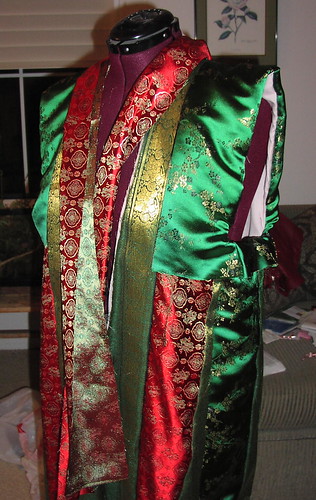
The decorative facings for the armholes are going in. I've laid out the collar pieces to see what more red looks like.
I was a bit worried about choosing the green for the contrasting decorative facing around the armholes, but after letting it sit for a while I ended up liking it as much as I did when I sketched out the design at the fabric store.
The side vents are not centered in the panel. If I make another panel coat, I won't make slashes in the lining before construction, like the instructions tell you to do. I'll wait in order to choose the location of the side vent after the lining goes in. That way I can stitch the seams for the slashed vent, then cut, making it a quicker and more stable process and allowing greater freedom in choosing where the vent goes. Cutting the pieces beforehand assumes perfect execution in cutting and sewing. With heavy or tricky fabrics, that's not going to happen easily. It was close, but not exactly centered after the lining was placed. I cut as accurately as I could, but things shift and some fabric does shift.
I like the colors and hope that this garment finds a really good home. I'm going to offer it at a charity auction.
Today the seams are almost all hidden. The lining was permanently added, the hems were evened up, the slash for the side vent was selected, and the facing was constructed and placed in with long stitches so I could see what it looked like.
The decorative facings for the armholes are going in. I've laid out the collar pieces to see what more red looks like.
I was a bit worried about choosing the green for the contrasting decorative facing around the armholes, but after letting it sit for a while I ended up liking it as much as I did when I sketched out the design at the fabric store.
The side vents are not centered in the panel. If I make another panel coat, I won't make slashes in the lining before construction, like the instructions tell you to do. I'll wait in order to choose the location of the side vent after the lining goes in. That way I can stitch the seams for the slashed vent, then cut, making it a quicker and more stable process and allowing greater freedom in choosing where the vent goes. Cutting the pieces beforehand assumes perfect execution in cutting and sewing. With heavy or tricky fabrics, that's not going to happen easily. It was close, but not exactly centered after the lining was placed. I cut as accurately as I could, but things shift and some fabric does shift.
I like the colors and hope that this garment finds a really good home. I'm going to offer it at a charity auction.
Robert W. Service
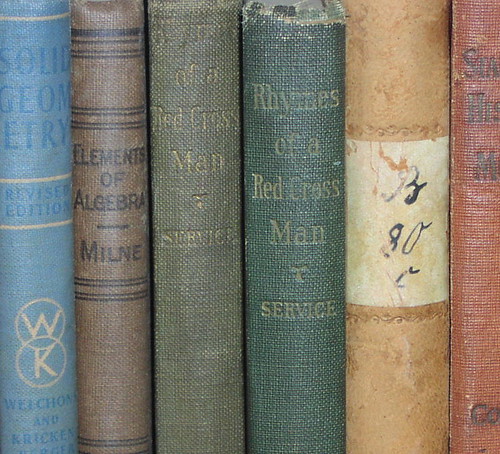
I owe a debt of thanks to Keith M. Wheeler for introducing me and many other people to the poetry of Robert W. Service. I still think Keith can recite it the best. I say this having heard several professionals attempt to perform his work. They did well, but Keith would easily own them on a stage.
Once, Keith recited The Men that Don't Fit In from memory at a bonfire. It was art.
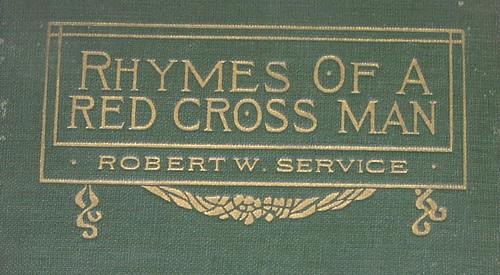
Here is one of the more humorous and therefore accessible poems that Service wrote. His work breaks down into to main types - the humorous poems and the poems about World War I. This one is about being cold and cranky in the ice and snow.
"There are strange things done in the midnight sun
By the men who moil for gold;
The Actic trails have their secret tales
That would make your blood run cold;
The Northern Lights have seen queer sights,
But the queerest they ever did see
Was that night on the marge of Lac LeBarge
I cremeated Sam McGee.
Now Sam McGee was from Tennessee, where the cotton blooms and blows.
Why he left his home in the South to roam 'round the pole, God only knows.
He was always cold, but the land of gold seemed to hold him like a spell;
Though he'd often say in his homely way that "he'd sooner live in hell."
On a Christmas Day we were mushing our way over the Dawson trail.
Talk of your cold! through the parka's fold it stabbed like a driven nail.
If our eyes we'd close, then the lashes froze till sometimes we couldn't see;
It wasn't much fun, but the only one to whimper was Sam McGee.
And that very night, as we lay packed tight in our robes beneath the snow,
And the dogs were fed, and the stars o'erhead were dancing heel and toe,
He turned to me, and "Cap," says he, "I'll cash in this trip, I guess;
And if I do, I'm asking that you won't refuse my last request."
Well, he seemed so low that I couldn't say no; then he says with a sort of moan:
"It's the cursed cold, and it's got right hold til I'm chilled clean through to the bone.
Yet 'tain't being dead - it's my awful dread of the icy grave that pains;
So I want you to swear that, foul or fair, you'll cremate my last remains."
A pal's last need is a thing to heed, so I swore I would not fail;
And we started on at the streak of dawn, but God! he looked ghastly pale.
He crouched on the sleigh, and he raved all day of his home in Tennessee;
And before nightfall a corpse was all that was left of Sam McGee.
There wasn't a breath in that land of death, and I hurried, horror-driven,
With a corpse half hid that I couldn't get rid, because of a promise given;
It was lashed to the sleigh, and it seemed to say: "You may tax your brawn and brains,
But you promised true, and it's up to you to cremate these last remains."
Now a promise made is a debt unpaid, and the trail has its own stern code.
In the days to come, though my lips were dumb, in my heart how I cursed that load.
In the long, long night, by the lone firelight, while the huskies, round in a ring,
Howled out their woes to the homeless snows - O God! how I loathed the thing.
And every day that quiet clay seemed to heavy and heavier grow;
And on I went, though the dogs were spent, and the grub was getting low;
The trail was bad, and I felt half mad, but I swore I would not give in;
And I'd often sing to the hateful thing, and it hearkened with a grin.
Til I came to the marge of Lac LeBarge, and a derelict there lay;
It was jammed in the ice, but I saw in a trice it was called the 'Alice May.'
And I looked at it, and I thought a bit, and I looked at my frozen chum;
Then, "Here," said I, with a sudden cry, "is my cre-ma-tor-eum."
Some planks I tore from the cabin floor, and I lit the boiler fire;
Some coal I found that was lying around, and I heaped the fuel higher;
The flames just soared, and the furnace roared - such a blaze you seldom see;
And I burrowed a hole in the glowing coal, and I stuffed in Sam McGee.
Then I made a hike, for I didn't like to hear him sizzle so;
And the heavens scowled, and the huskies howled, and the wind began to blow;
It was icy cold, but the hot sweat rolled down my cheeks, and I don't know why;
And the greasy smoke in an inky cloak went streaking down the sky.
I do not know how long in the snow I wrestled with grisly fear;
But the stars came out and they danced about ere again I ventured near;
I was sick with dread, but I bravely said: "I'll just take a peep inside.
I guess he's cooked, and it's time I looked;"... then the door I opened wide.
And there sat Sam, looking cool and calm, in the heart of the furnace roar;
And he wore a smile you could see a mile, and he said: "Please close that door!
It's warm in here, but I greatly fear you'll let in the cold and storm--
Since I left Plumtree, down in Tennessee, it's the first time I've been warm."
There are strange things done in the midnight sun
By the men who moil for gold;
The Actic trails have their secret tales
That would make your blood run cold;
The Northern Lights have seen queer sights,
But the queerest they ever did see
Was that night on the marge of Lac LeBarge
I cremeated Sam McGee."
Monday, January 17, 2005
Sewing Project Update 4: Tibetan Panel Coat
There are 33 pattern pieces to a typical Tibetan Panel Coat. This sounds like a lot. It actually is a lot. Quilts can have hundreds of pieces, but clothing usually tops out at ten or eleven. 33 is plenty.
In order to organize the pieces, I wrapped each type of pattern piece in a paper towel. On the paper towel I wrote down the name, type of fabric, quantity, and label from the instructions. I stacked them out of the way and kept cutting. There were five different fabrics, thirty-three individual pieces, and fourteen paper towel packets.
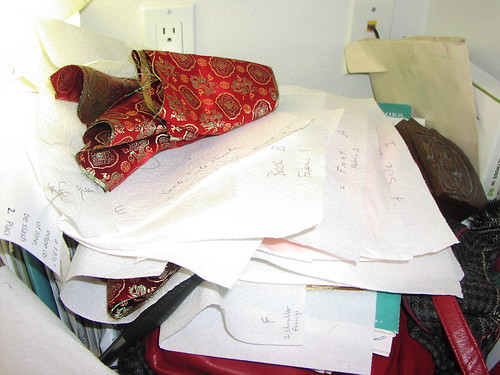
Here I am beginning the process of sewing the long strips together to make the back, sides, and front of the coat. Tibetan coats don't have sleeves. The coat is formed from long rectangles and skinny triangles. I used a rotary cutter to slice the fabric into the pattern pieces, following the Tibetan Panel Coat design in the Folkwear book.
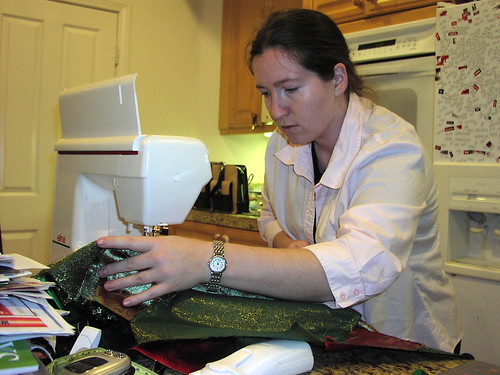
Here is the center back panel coming together with the side panels.
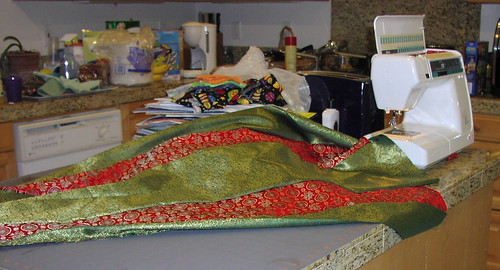
This is the center front panels coming together.
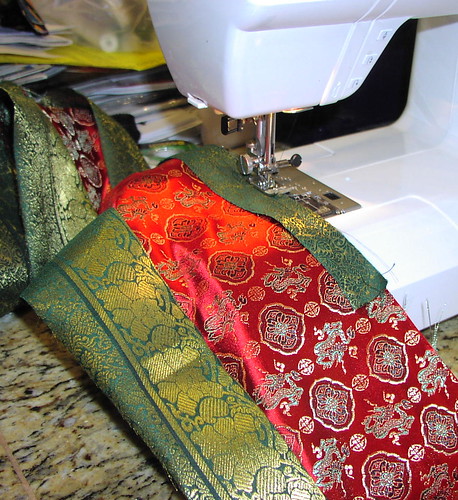
Front, back, and side coming together. The colors are red and green, with peach lining and peach and gold fabric for the facing, which I hope to get to tomorrow. Cutting out the fabric took most of the first day, working very lightly. Sewing the body of the coat took most of the second day, also working very lightly.
I've noticed that I've chosen a large amount of green fabric for these three projects - the Ranger Burnoose, the Chrysanthemum Burnoose, and the Tibetan Panel Coat. I do really like green and I tend to go with my gut when picking out colors. I originally intended to get some rich blues for at least one Burnoose, but there were not any blue brocades available at the fabric store that day. Since the post-holiday sales were in full swing, reds and greens dominated the fabric store landscape, and ended up being the colors I brought home.
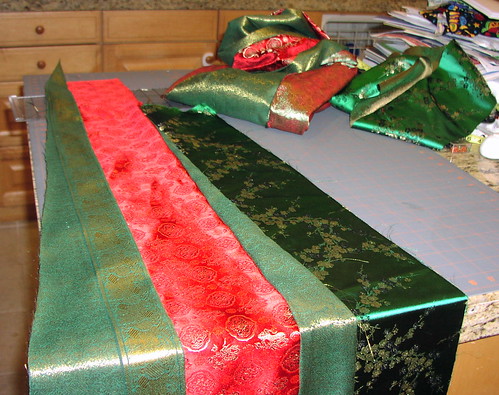
Here is the coat, with lining pinned on the inside, on the dressform.
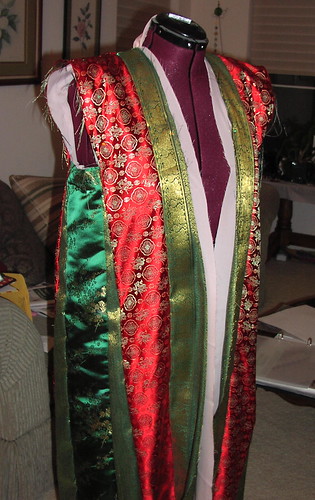
This is the bottom half of the coat on the dressform. Not sure why it's so uneven after all that careful measuring, but whenever I do the hem, I'm sure it will all work out.
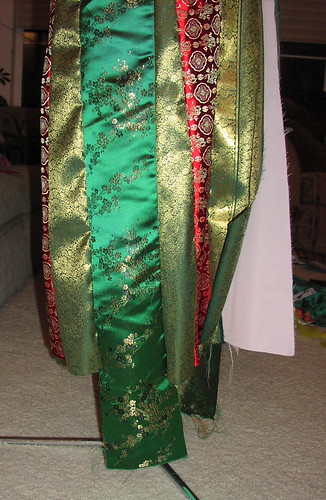
The book that I got the patterns for the Burnoose and the Tibetan Panel Coat is called The Folkwear Book of Ethnic Clothing : Easy Ways to Sew & Embellish Fabulous Garments from Around the World and is by Mary Parker. It's a beautifully illustrated book with solid descriptions and only slightly cramped sewing instructions for the projects within it.
In order to organize the pieces, I wrapped each type of pattern piece in a paper towel. On the paper towel I wrote down the name, type of fabric, quantity, and label from the instructions. I stacked them out of the way and kept cutting. There were five different fabrics, thirty-three individual pieces, and fourteen paper towel packets.
Here I am beginning the process of sewing the long strips together to make the back, sides, and front of the coat. Tibetan coats don't have sleeves. The coat is formed from long rectangles and skinny triangles. I used a rotary cutter to slice the fabric into the pattern pieces, following the Tibetan Panel Coat design in the Folkwear book.
Here is the center back panel coming together with the side panels.
This is the center front panels coming together.
Front, back, and side coming together. The colors are red and green, with peach lining and peach and gold fabric for the facing, which I hope to get to tomorrow. Cutting out the fabric took most of the first day, working very lightly. Sewing the body of the coat took most of the second day, also working very lightly.
I've noticed that I've chosen a large amount of green fabric for these three projects - the Ranger Burnoose, the Chrysanthemum Burnoose, and the Tibetan Panel Coat. I do really like green and I tend to go with my gut when picking out colors. I originally intended to get some rich blues for at least one Burnoose, but there were not any blue brocades available at the fabric store that day. Since the post-holiday sales were in full swing, reds and greens dominated the fabric store landscape, and ended up being the colors I brought home.
Here is the coat, with lining pinned on the inside, on the dressform.
This is the bottom half of the coat on the dressform. Not sure why it's so uneven after all that careful measuring, but whenever I do the hem, I'm sure it will all work out.
The book that I got the patterns for the Burnoose and the Tibetan Panel Coat is called The Folkwear Book of Ethnic Clothing : Easy Ways to Sew & Embellish Fabulous Garments from Around the World and is by Mary Parker. It's a beautifully illustrated book with solid descriptions and only slightly cramped sewing instructions for the projects within it.
Sunday, January 16, 2005

Sewing Project Update #3: The Tibetan Panel Coat
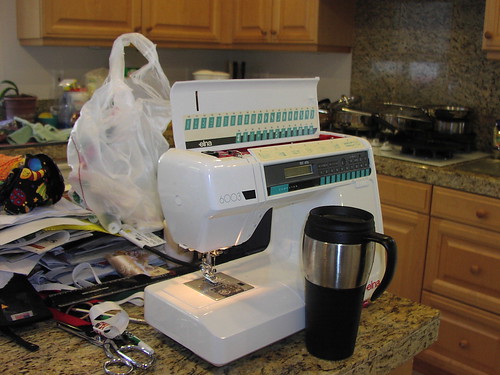
Here's my sewing machine, set up in the kitchen. Disregard the mess behind the curtain.
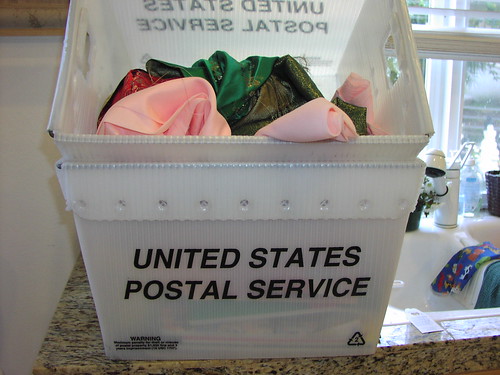
Here's all the fabric in the holding tank for the Tibetan Panel Coat. You can tell I check the mail on a regular basis, can't you?
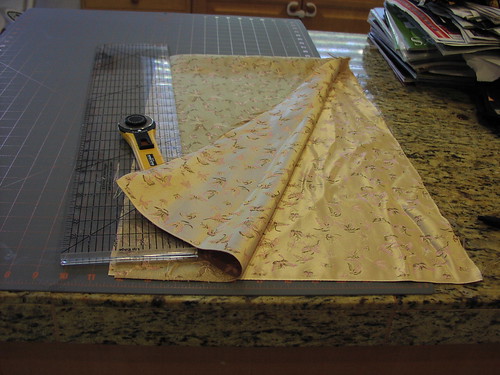
OK here we go. We're beginning to cut out all the pieces for the panel coat. There are four brocades and a lining fabric. I'll count up all the pieces for my next update and tell you how many strips of cloth go into a typical Tibetan Panel Coat.
Sewing Project Update #2: The Ranger Burnoose
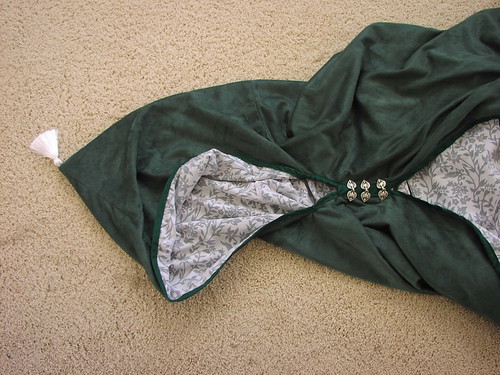
This is a view of the hood and inner lining. Note cute tassel. I had to repair tassel after it started to unravel.
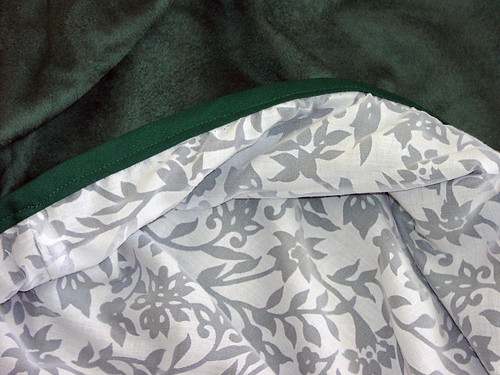
Here is a close-up of the inner lining (white patterned fabric) against the dark green outer fabric (microfiber suede). You can see the forest green binding I used to put the two fabrics together. I didn't try to stitch in the ditch to hide the seamline as it would have taken a long time and I didn't mind seeing some topstitch-style threads. For the Chrysanthemum Burnose, though, I might try and finesse the binding like you're supposed to.
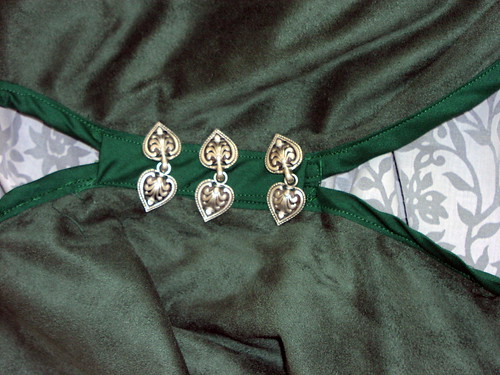
Here is the closure. A burnoose is actually sewn shut at the front. The silver closures are there as a decoration and are not really functional.
Tuesday, January 11, 2005
Beach
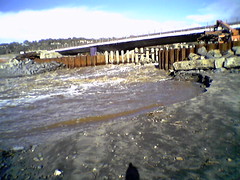
High, fast water at torrey pines state beach. Penasquitos Creek empties into Penasquitos Lagoon which empties out into the ocean here under this bridge. The beach is being eroded away and the heavy brown river is a marked contrast against the deeply green ocean today. The standing waves at the interface between the river and the ocean are dramatic. Water is moving fast and thunders up against the pilings of the bridge.
Water level, del mar, ca.
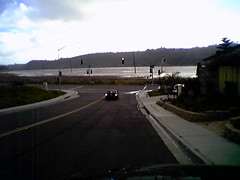
Water level up almost even to roadbed along Carmel Valley Rd near Del Mar and Torrey Pines neighborhoods.
Subscribe to:
Posts (Atom)